Standard AWD & Driver-Focused Character or More Space & MPG Choice? The Better Fit Depends on the Routine.
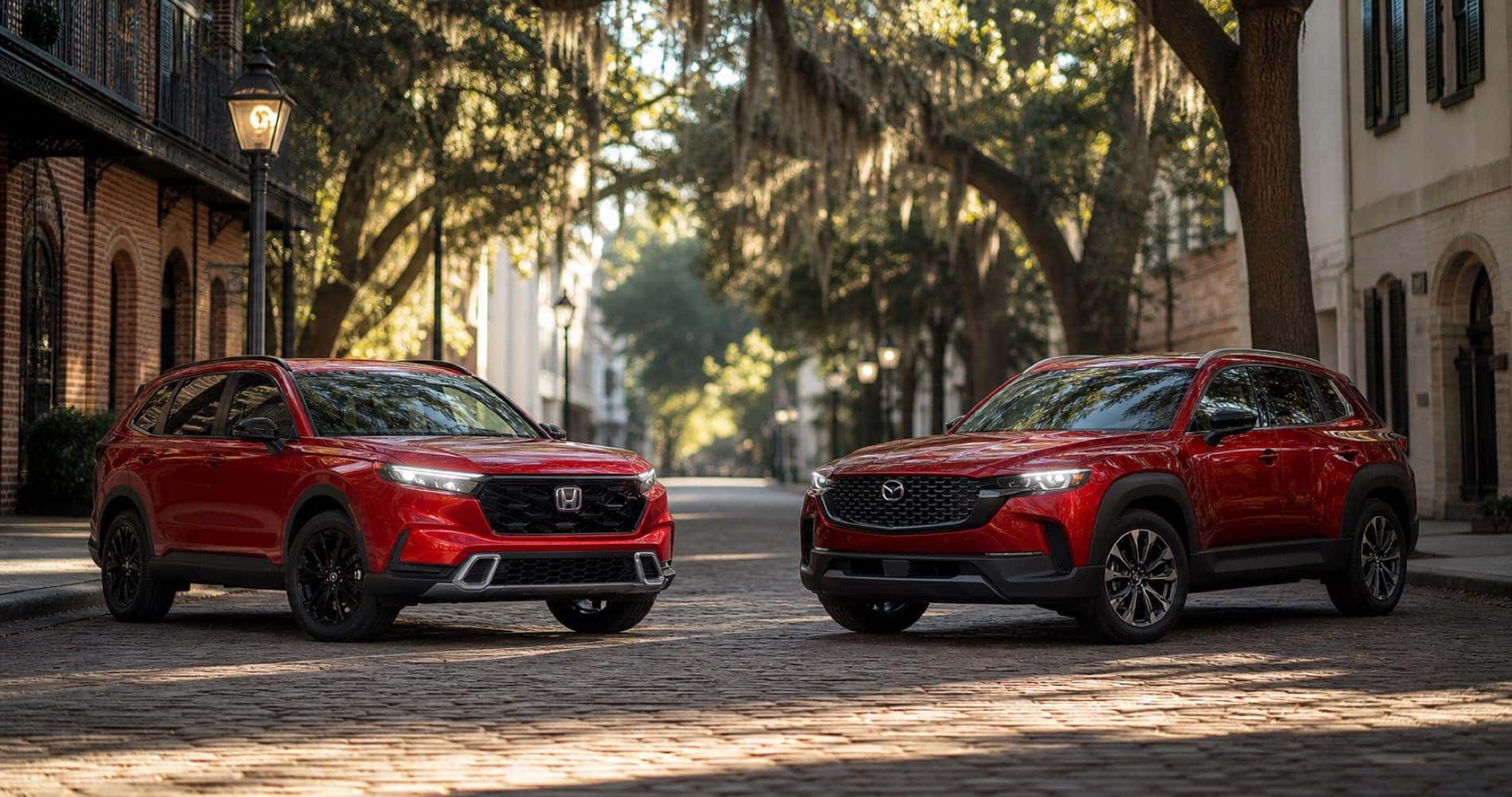
The 2026 Mazda CX-50 Hybrid and 2026 Honda CR-V Hybrid belong on the same Savannah-area shortlist for shoppers who want compact-SUV versatility with a no-plug hybrid powertrain. Both can handle family errands, commuter miles, and longer regional drives without asking the driver to change a daily charging routine, but they organize the ownership experience differently.
The CX-50 Hybrid puts all-wheel drive and Mazda’s more road-focused character at the center of every trim. The CR-V Hybrid gives shoppers a broader drivetrain choice and makes passenger and cargo space a bigger part of its appeal. That means the better fit is less about which vehicle has the longer feature list and more about whether your repeated priorities favor standard AWD and driving feel or maximum everyday room and efficiency flexibility.
Around Savannah, those tradeoffs can matter in different ways: steady I-16 or I-95 mileage can put fuel economy high on the list, while family trips toward the South Carolina Lowcountry can make rear-seat comfort and cargo packing more important. This comparison works through the differences that can actually change the decision, then gives you a practical starting point for what to test in person.
Which Priority Should Lead Your Hybrid SUV Shortlist?
Choose the priority that repeats most often in your week. This gives you a directional starting point; the detailed comparison below shows where drivetrain, trim, or configuration can change the answer.
Based on This Priority
Standard AWD & Driving Feel Matter
Start With the CX-50 Hybrid
Who This Favors
Drivers who want electronic all-wheel drive included on every hybrid trim and put meaningful weight on steering response and a more driver-focused road feel.
Why It Points Here
Every CX-50 Hybrid includes electronic AWD, and its steering and chassis tuning give the Mazda a more driver-focused emphasis in this comparison.
CX-50 Hybrid vs CR-V Hybrid in 60 SecondsSix answers that clarify the current comparison▼
Which hybrid starts at the lower price? The CX-50 Hybrid. The Hybrid Preferred starts at $34,750 with electronic AWD standard. The CR-V Sport Hybrid starts at $35,630 with front-wheel drive or $37,130 with AWD. Those figures exclude destination and handling.
Which has more hybrid system output? The CX-50 Hybrid is rated at 219 total system horsepower, compared with 204 total system horsepower for the CR-V Hybrid.
Which gets better fuel economy? The CR-V Hybrid reaches the higher ceiling when front-wheel drive works for you: Sport Hybrid and Sport-L Hybrid FWD configurations are rated at 43 city / 36 highway / 40 combined MPG. The CX-50 Hybrid is rated at 39 / 37 / 38 MPG with AWD standard; most AWD CR-V Hybrid configurations are rated at 40 / 34 / 37 MPG.
Which has more cargo room? The CR-V Hybrid. It provides 36.3 cubic feet behind the rear seat and 71.8 cubic feet with the rear seat folded, compared with 29.2 and 56.3 cubic feet respectively in the CX-50 Hybrid.
Which hybrid can tow more? The CX-50 Hybrid is rated to tow up to 1,500 pounds when properly equipped, while the CR-V Hybrid is rated up to 1,000 pounds.
Do both hybrids have AWD? AWD is standard on every CX-50 Hybrid. The CR-V Hybrid offers Real Time AWD on Sport Hybrid and Sport-L Hybrid, while TrailSport Hybrid and Sport Touring Hybrid include AWD standard.
Where Do the CX-50 Hybrid & CR-V Hybrid Start to Feel Like Different SUVs?
Start with the biggest ownership split - standard AWD and a more driver-focused Mazda personality versus the Honda's greater interior room and wider drivetrain strategy - then compare the details that can change the first impression: efficiency, rear-seat and cargo space, towing, clearance, technology, and what each trim ladder asks you to pay for.
Start With the Big Decision; Then Compare by Priority
Start Here
What Changes the Decision Before You Get Into the Details?
Both are five-passenger no-plug hybrids, but they are not chasing exactly the same ownership priorities. The CX-50 Hybrid makes AWD standard and starts lower than an AWD CR-V Hybrid, while the Honda creates more rear-seat and cargo room and offers a higher-efficiency front-wheel-drive path.
2026 Mazda CX-50 Hybrid vs 2026 Honda CR-V Hybrid at a Glance
Category
2026 Mazda CX-50 Hybrid
2026 Honda CR-V Hybrid
Starting MSRP*
$34,750 Hybrid Preferred e-AWD
FWD: $35,630 AWD: $37,130 Sport Hybrid
Hybrid System Output
219 total hp
204 total hp
Drivetrain Strategy
All trims: electronic AWD standard
Sport / Sport-L: FWD or available AWD TrailSport / Sport Touring: AWD standard
Best Combined MPG*
38 MPG 39 city / 37 highway with AWD
40 MPG 43 city / 36 highway with FWD
Passenger / Cargo Space*
Passenger volume: 97.0 cu ft Cargo, seat up: 29.2 cu ft Maximum cargo: 56.3 cu ft
Passenger volume: 103.5 cu ft Cargo, seat up: 36.3 cu ft Maximum cargo: 71.8 cu ft
Ground Clearance
Hybrid Preferred / Premium: 7.8 in Hybrid Premium Plus: 8.1 in
FWD: 7.8 in AWD: 8.2 in
Maximum Hybrid Towing*
Up to 1,500 lb
Up to 1,000 lb
MSRP excludes destination and handling, taxes, title, license, options, accessories, dealer-installed equipment, and dealer charges. EPA estimates vary by drivetrain and trim. Cargo, passenger, clearance, and towing figures vary by configuration and required equipment.
The First Split Is AWD Value Versus Interior Space
The Mazda starts lower than an AWD CR-V Hybrid and includes its electronic AWD system on every trim, while the Honda delivers a much larger passenger-and-cargo envelope and can reach a higher combined MPG rating in front-wheel-drive form. Decide which of those advantages you would use every week before smaller feature differences start moving the shortlist.
Hybrid System & Efficiency
How Much Should Drivetrain Choice Shape the MPG Decision?
Both hybrids avoid plug-in charging, but their efficiency strategies differ. Mazda packages one AWD hybrid formula across the lineup. Honda lets Sport Hybrid and Sport-L Hybrid shoppers choose FWD or AWD, which creates a higher maximum MPG path but also makes drivetrain selection part of the purchase decision.
Engine: 2.5L four-cylinder Electric drive: three-motor hybrid system Transmission: electronically controlled CVT
Engine: 2.0L four-cylinder Electric drive: two-motor hybrid system Transmission: electronic continuously variable transmission
Total System Output
219 hp
204 hp
Drivetrain Choice
Electronic AWD: standard on every Hybrid trim FWD: not offered
Sport / Sport-L: FWD or available Real Time AWD TrailSport / Sport Touring: Real Time AWD standard
EPA Estimates - FWD*
No FWD hybrid configuration
Sport / Sport-L: 43 city / 36 highway / 40 combined MPG
EPA Estimates - AWD*
All Hybrid trims: 39 city / 37 highway / 38 combined MPG
Sport / Sport-L / Sport Touring: 40 city / 34 highway / 37 combined MPG TrailSport: 38 / 33 / 35 MPG
Drive Modes
Mi-Drive: Power & Trail modes
Selectable modes: Normal, ECON, Snow & Sport Availability varies by trim/drivetrain.
EPA estimates vary by drivetrain and trim. Actual mileage varies with traffic, speed, temperature, climate use, loading, vehicle condition, fuel, and driving habits. Both vehicles use no-plug hybrid systems.
The Best MPG Number Depends on Whether FWD Is Acceptable
For long stretches of Savannah-area commuting, the CR-V's 40-combined-MPG FWD route can reduce fuel use the most on paper. If AWD is already a non-negotiable part of the purchase, the comparison tightens: the CX-50 Hybrid's 38 combined MPG edges the 37-combined rating of most AWD CR-V Hybrid configurations while also making AWD standard at every trim level.
Passenger & Cargo Space
How Much Does Interior Packaging Matter Once People & Gear Share the Cabin?
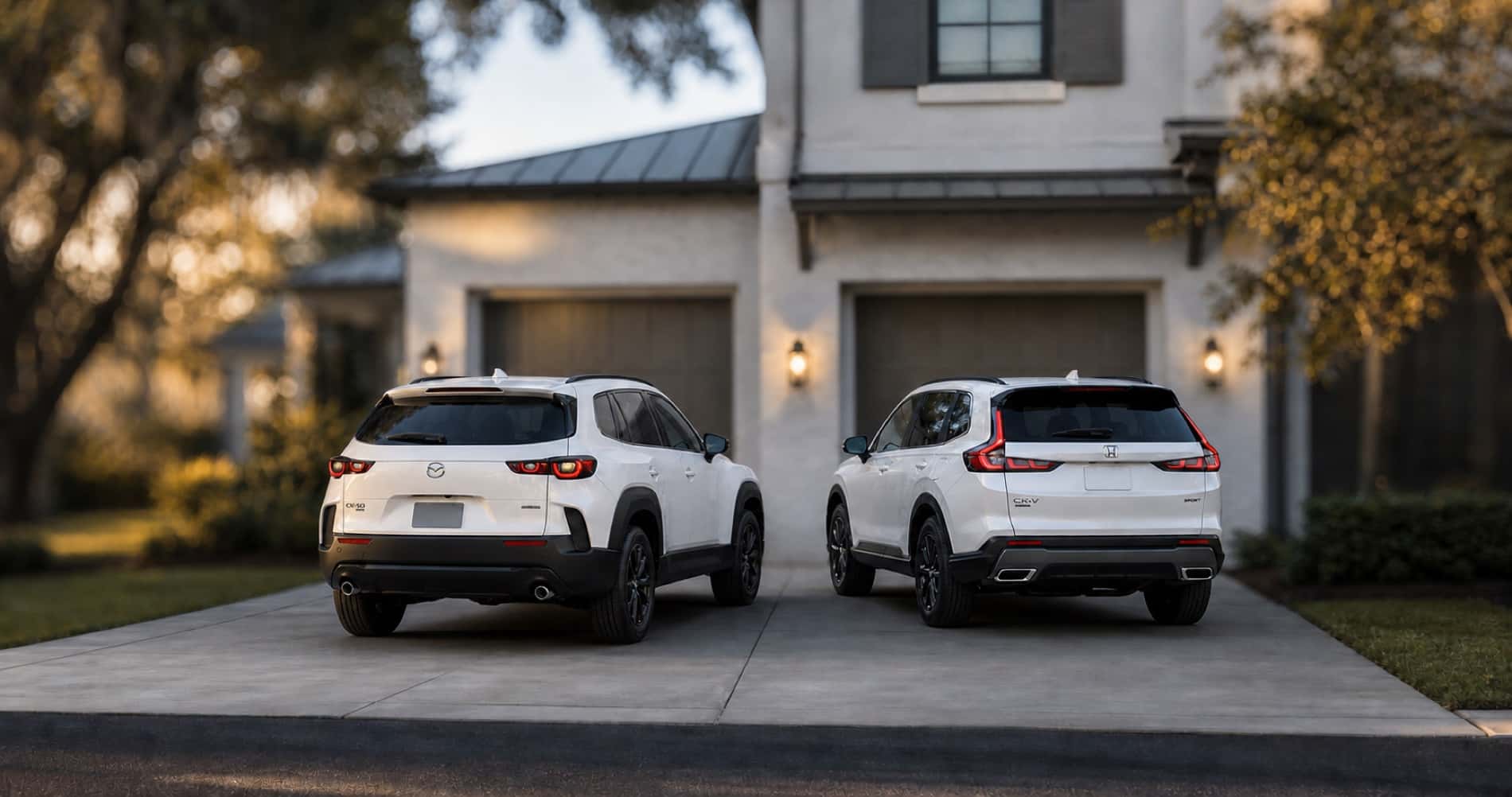
The exterior dimensions are close enough that either SUV still fits the compact-crossover role, but their interiors use that footprint differently. The CR-V Hybrid devotes more of its package to rear-seat legroom and cargo volume, while the CX-50 Hybrid uses a longer wheelbase yet leaves less published room behind the second row.
Footprint, Passenger Room & Cargo Comparison
Category
2026 Mazda CX-50 Hybrid
2026 Honda CR-V Hybrid
Exterior Footprint
Length: 186.1 in Wheelbase: 110.8 in
Length: 184.8 in Wheelbase: 106.3 in
Passenger Capacity
Five passengers
Front / Rear Legroom
41.7 / 37.8 in
41.3 / 41.0 in
Passenger Volume*
97.0 cu ft
103.5 cu ft
Cargo Behind Rear Seat*
29.2 cu ft
36.3 cu ft
Maximum Cargo*
56.3 cu ft with rear seatbacks folded
71.8 cu ft with rear seat folded
Published passenger and cargo measurements can vary by configuration and measurement method. Load the people and gear you regularly carry and confirm the exact vehicle's seating and cargo fit in person.
The CR-V Hybrid Turns a Slightly Shorter Body Into More Usable Interior Room
This is the Honda's clearest structural advantage. Its rear passengers get 3.2 inches more published legroom, and the cargo difference grows from 7.1 cubic feet behind an occupied second row to 15.5 cubic feet with that row folded. For family trips toward Hilton Head or a busy airport run with passengers and luggage together, that extra space can matter more than exterior size suggests.
AWD, Clearance & Towing
When Do AWD, Ground Clearance & Light Towing Change the Shortlist?
Neither hybrid is built around heavy trailer work, but the Mazda gives capability a little more emphasis. The CX-50 Hybrid includes AWD across the lineup, carries the higher towing rating, and includes Trail mode; the Honda lets some shoppers trade AWD for better fuel economy and still offers AWD-focused choices higher in the lineup.
AWD, Ground Clearance & Towing Comparison
Category
2026 Mazda CX-50 Hybrid
2026 Honda CR-V Hybrid
AWD Baseline
All trims: electronic AWD standard
Sport / Sport-L: available Real Time AWD TrailSport / Sport Touring: Real Time AWD standard
Ground Clearance
Preferred / Premium: 7.8 in Premium Plus: 8.1 in
FWD: 7.8 in AWD: 8.2 in
Maximum Hybrid Towing*
Up to 1,500 lb
Up to 1,000 lb
Low-Traction / Trail Strategy
Mi-Drive: Trail mode standard AWD: standard on every trim
AWD system: available or standard by trim TrailSport: all-terrain tires & trim-specific capability equipment
Maximum towing requires proper equipment and must be reduced for applicable passenger, cargo, hitch, accessory, and equipment weight. Ground clearance, AWD, drive-mode, tire, and trim-specific capability equipment vary by configuration.
The Mazda Builds More Capability Into the Hybrid Baseline
If AWD and occasional light towing are already part of the plan, the CX-50 Hybrid asks for fewer configuration decisions: every trim includes AWD, Trail mode is standard, and the 1,500-pound towing ceiling is 500 pounds higher. The CR-V Hybrid can counter with 8.2 inches of clearance in AWD form and the dedicated TrailSport trim, but shoppers who do not need AWD can instead prioritize its stronger FWD fuel-economy rating.
Technology & Comfort
Which Cabin Differences Will You Notice on an Ordinary Drive?
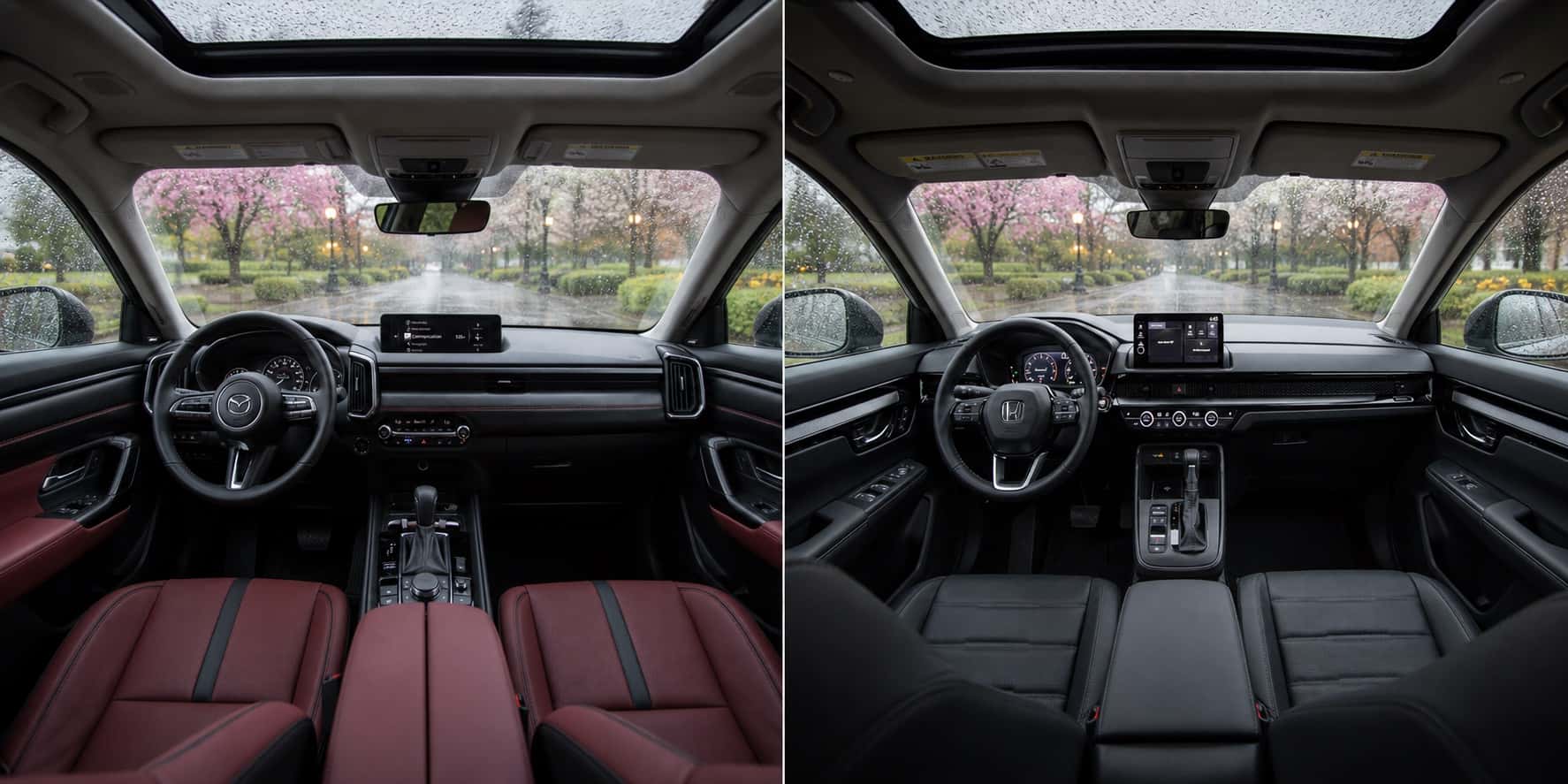
The core connectivity baseline is close: both make wireless phone integration and wireless charging easy to get. The difference is how the controls and upper-trim equipment are organized, with Mazda using a wider center display and commander-based interface while Honda puts more emphasis on touch operation and expands its digital cluster and connected features as you move up the hybrid lineup.
Connectivity, Displays, Audio & Comfort Features
Category
2026 Mazda CX-50 Hybrid
2026 Honda CR-V Hybrid
Center Display
Standard: 10.25-in full-color display Interface: Mazda Connect with Multifunction Commander
Standard: 9-in touchscreen
Phone & Charging
Standard: wireless Apple CarPlay & Android Auto Voice: Alexa Built-in Charging: wireless phone charger
Standard: wireless Apple CarPlay & Android Auto Charging: wireless phone charger
Driver Display
Gauge display: 7-in LCD meter display Upper trim: windshield-projected Active Driving Display available
Sport Hybrid: 7-in driver information interface Upper Hybrid trims: 10.2-in digital instrument display
Premium Audio
Available: Bose 12-speaker surround sound
Sport Touring Hybrid: Bose 12-speaker premium sound system
Upper-Trim Comfort & Convenience
Leather seating available
Ventilated front seats available
Heated rear seats available
360-degree View Monitor available
Leather-trimmed seating available
Google built-in on Sport Touring Hybrid
Hands-free access power tailgate on Sport Touring Hybrid
Heated front seats across the Hybrid lineup
Feature availability varies by trim, device, subscription status, service availability, and equipment package. Driver-assistance technologies do not replace attentive driving or direct visual confirmation.
Core Connectivity Is Close; the Interface Preference Is More Personal
Both make wireless smartphone integration and charging part of the everyday experience, so the more useful test is how you interact with the cabin. Try Mazda's commander-based 10.25-inch system against Honda's 9-inch touchscreen, then decide whether upper-trim extras such as a head-up display, Google built-in, upgraded audio, or added seating comfort are worth moving up the price ladder.
Price & Lineup Strategy
What Are You Actually Paying More to Get?
Mazda keeps the hybrid ladder simple with three all-wheel-drive trims. Honda creates four distinct hybrid trim names and adds FWD/AWD choice on two of them, which gives shoppers more ways to balance efficiency, equipment, and drivetrain but also creates more configuration overlap.
Hybrid Lineup Roles & Starting MSRP Comparison
Lineup Role
2026 Mazda CX-50 Hybrid
2026 Honda CR-V Hybrid
Hybrid Starting Point*
Hybrid Preferred e-AWD - $34,750
Sport Hybrid FWD - $35,630 Sport Hybrid AWD - $37,130
Three hybrid trims: all use the same 219-hp e-AWD system
Four hybrid trims: FWD/AWD choice on Sport and Sport-L; AWD standard on TrailSport and Sport Touring
Current starting MSRP figures exclude destination and handling, taxes, title, license, options, accessories, dealer-installed equipment, and dealer charges. Pricing, incentives, configuration availability, and equipment can change.
Mazda Keeps the AWD Price Ladder Simpler
The CX-50 Hybrid starts $2,380 below an AWD CR-V Sport Hybrid and tops out $2,100 below the CR-V Sport Touring Hybrid. Honda's broader lineup can justify that extra complexity when you specifically want a FWD efficiency route, the TrailSport package, or the CR-V's larger interior; Mazda's three-trim structure is easier to shop when AWD is already part of the requirement.
Independent Review Context
Space & Refinement on One Side, Road Feel on the Other
Car and Driver's reviews reinforce the same split that appears in the comparison: the CR-V Hybrid stands out for space, refinement, and everyday usability, while the CX-50 Hybrid earns praise for engaging handling and an upscale-feeling cabin. Their instrumented tests also put acceleration and real-world cargo capacity into more concrete terms.
Car and Driver
2026 Mazda CX-50 Hybrid
Enjoyable handling, a near-luxury interior, and far better fuel economy than the gas CX-50.
Car and Driver's 2026 review highlights the CX-50 Hybrid's engaging road manners and upscale-feeling cabin. In the publication's instrumented testing of a 2025 CX-50 Hybrid, it reached 60 mph in 7.6 seconds, while the cargo test fit eight carry-on cases behind the second row and 20 with it folded. Those results reinforce the Mazda's more driver-focused character while also showing the practical space tradeoff against the Honda.
Roomy, refined, efficient, and exceptionally practical for everyday compact-SUV use.
Car and Driver highlights the CR-V Hybrid's roomy cabin, refined road manners, and everyday versatility. In instrumented testing, a Sport Touring Hybrid reached 60 mph in 7.1 seconds, and the publication fit 11 carry-on cases behind the second row and 29 with it folded. Those results make the Honda's acceleration and cargo strengths more concrete, while the Mazda's review remains centered on steering feel and cabin character.
Find the CX-50 Hybrid Configuration You Want to Test
Review current CX-50 Hybrid inventory, compare Preferred, Premium, and Premium Plus equipment, then use the test drive to focus on the tradeoffs that matter most against the CR-V Hybrid: rear-seat fit, cargo usability, AWD response, cabin controls, and the Mazda's road feel.
The Mazda makes the strongest case when AWD is already non-negotiable and you would rather keep the drivetrain decision simple. Its Hybrid Preferred starts below an AWD CR-V Sport Hybrid, all three trims keep the same 219-horsepower e-AWD system, and the 1,500-pound towing rating adds useful light-trailer flexibility. For a Savannah-area routine that does not regularly max out the rear seat and cargo area together, that trade can make sense: you give up space you may use occasionally in exchange for AWD consistency and the road feel you notice on every drive.
The Honda makes the stronger case when the rear seat and cargo area stay busy or when FWD is perfectly acceptable. Its larger interior asks less compromise from households that regularly carry adults, child seats, luggage, or sports gear together, while the 40-MPG FWD route adds another advantage for drivers who do not need AWD. For Savannah airport runs or family weekends toward Hilton Head, those benefits can matter on every loaded trip. The final choice is less about a universal winner than the compromise you would rather live with: less interior room in the Mazda, or more configuration complexity and a higher AWD entry price in the Honda.
Still Split Between Standard AWD & More Interior Room? Use the Quiz to Let Your Repeated Priorities Settle It.
4-Question Fit Check
Find Your Better Hybrid SUV Starting Point
Answer four questions about space, drivetrain and efficiency, capability, and the price-versus-room tradeoff. The result points you toward the vehicle to investigate first; it does not replace driving and loading the exact configuration.
Use these four questions as a decision checklist:
How often do rear-seat passengers and cargo need maximum room at the same time?
Do you want AWD standard, or would you choose FWD for the highest fuel-economy rating?
Do the Mazda's higher towing rating and driver-focused road feel matter more than the Honda's room and refinement?
Would you rather start lower with AWD included or spend more for the CR-V Hybrid's larger interior package?
If JavaScript is unavailable, the four questions above still provide a useful checklist for comparing the two hybrids in person.
Quiz results are general shopping guidance. Final fit depends on the exact drivetrain, trim, equipment, pricing, passengers, cargo, towing needs, and your driving routine.
Mazda CX-50 Hybrid vs Honda CR-V Hybrid FAQs
Do either the Mazda CX-50 Hybrid or Honda CR-V Hybrid need to be plugged in?▼
No. Both are conventional no-plug hybrids that refuel with gasoline and recover energy through their hybrid systems while driving. The CX-50 Hybrid pairs a 2.5-liter engine with a three-motor hybrid system and e-AWD, while the CR-V Hybrid uses a 2.0-liter engine with Honda's two-motor hybrid system.
Which hybrid is easier to configure?▼
The CX-50 Hybrid is simpler to shop because Preferred, Premium, and Premium Plus all use the same 219-horsepower hybrid system, e-AWD, and 38-combined-MPG rating. The CR-V Hybrid has four hybrid trims, with FWD or AWD available on Sport Hybrid and Sport-L Hybrid and AWD standard on TrailSport Hybrid and Sport Touring Hybrid. Honda offers more ways to tailor the drivetrain; Mazda asks for fewer drivetrain decisions.
Does the CX-50 Hybrid have a trail-oriented trim like the CR-V TrailSport Hybrid?▼
Not as a separate hybrid trim. Trail mode is standard across the CX-50 Hybrid lineup, with 7.8 inches of ground clearance on Preferred and Premium and 8.1 inches on Premium Plus. Honda's TrailSport Hybrid is a dedicated AWD trim with all-terrain tires and 8.2 inches of ground clearance.
Which hybrid makes more sense if I want AWD and strong fuel economy?▼
The CX-50 Hybrid is rated at 38 MPG combined with e-AWD standard on every trim. Most AWD CR-V Hybrid configurations are rated at 37 MPG combined, while TrailSport Hybrid is rated at 35 MPG combined. If FWD works for you, Honda reaches the higher ceiling at 40 MPG combined.
Which is the better family fit when the second row stays busy?▼
The CR-V Hybrid has the clearer space advantage, with 41.0 inches of rear legroom, 36.3 cubic feet behind the second row, and 71.8 cubic feet with it folded. The CX-50 Hybrid provides 37.8 inches of rear legroom, 29.2 cubic feet behind the second row, and 56.3 cubic feet maximum. If adults, child seats, and cargo regularly travel together, load both vehicles the way you actually use them before deciding.
What should I compare during a test drive?▼
Use the same seating and cargo routine in both vehicles. In the CX-50 Hybrid, pay attention to seat comfort, steering response, visibility, and the commander-based infotainment controls. In the CR-V Hybrid, check rear-seat access, cargo usability, touchscreen operation, and overall ride refinement. The best choice is the one whose everyday strengths match the things you notice most.
Where can I shop a Mazda CX-50 Hybrid near Savannah, GA?▼
J.C. Lewis Mazda is located at 10101 Abercorn St in Savannah, Georgia. Shoppers can compare current CX-50 Hybrid inventory, review Preferred, Premium, and Premium Plus equipment, and use the dealership's trade, financing, and payment tools before deciding which Mazda configuration fits their routine.
Shopping & Ownership Support
How J.C. Lewis Mazda Can Make the CX-50 Hybrid Decision Easier
A hybrid comparison becomes easier to act on when the next step is built around the exact vehicle rather than a generic feature checklist. At J.C. Lewis Mazda in Savannah, comparing current CX-50 Hybrid inventory alongside the Preferred, Premium, and Premium Plus equipment differences can help narrow the equipment decision before the drive. That leaves the in-person evaluation focused on the questions a table cannot settle: front-seat comfort, rear-seat fit, cargo access, visibility, control layout, and whether the Mazda's steering and road feel are worth choosing over the Honda's larger interior.
The dealership's online finance application, payment calculator, and trade-value tools can reduce the number of purchase questions that still need to be handled at the store. For a shopper coming from Pooler, Richmond Hill, or elsewhere in the Savannah-Lowcountry region, completing more of that practical work online can mean fewer transaction steps competing with the time you wanted to spend evaluating the CX-50 Hybrid itself.
After purchase, J.C. Lewis Mazda provides Mazda-trained service technicians, Genuine Mazda Parts, online service scheduling, and Saturday service hours. Online scheduling and an additional Saturday service window can make routine maintenance easier to fit around work and family responsibilities, while Mazda-trained technicians and Genuine Mazda Parts keep brand-specific service support in the same ownership relationship.
Where to Go Next
Start Shopping or Keep Researching
Ready to Shop?
Compare current CX-50 Hybrid inventory, current Mazda offers, financing, payments, and trade value around the exact configuration you would consider.
Disclaimers:
*Vehicle specifications, pricing, features, towing capability, fuel-economy estimates, and availability are current as of August 2026 and may change.
*Starting MSRP excludes destination and handling, taxes, title, license, options, accessories, dealer-installed equipment, and dealer charges.
*EPA estimates are for comparison purposes; actual mileage varies by traffic, speed, temperature, climate use, loading, vehicle condition, fuel, and driving habits.
*Towing requires proper equipment and adherence to manufacturer loading limits; passenger, cargo, hitch, accessory, and equipment weight can reduce available towing capacity.
*Cargo and passenger measurements can vary by configuration and measurement method.
*Third-party review observations and instrumented test results belong to the cited publication and specific evaluation basis.
*Driver-assistance features do not replace attentive driving. Confirm exact equipment, pricing, and availability on the specific vehicle before purchase.