2026 Mazda CX-50 Hybrid vs 2026 Toyota RAV4 Hybrid
Mazda Driving Character, Toyota Efficiency & the Right Everyday Fit
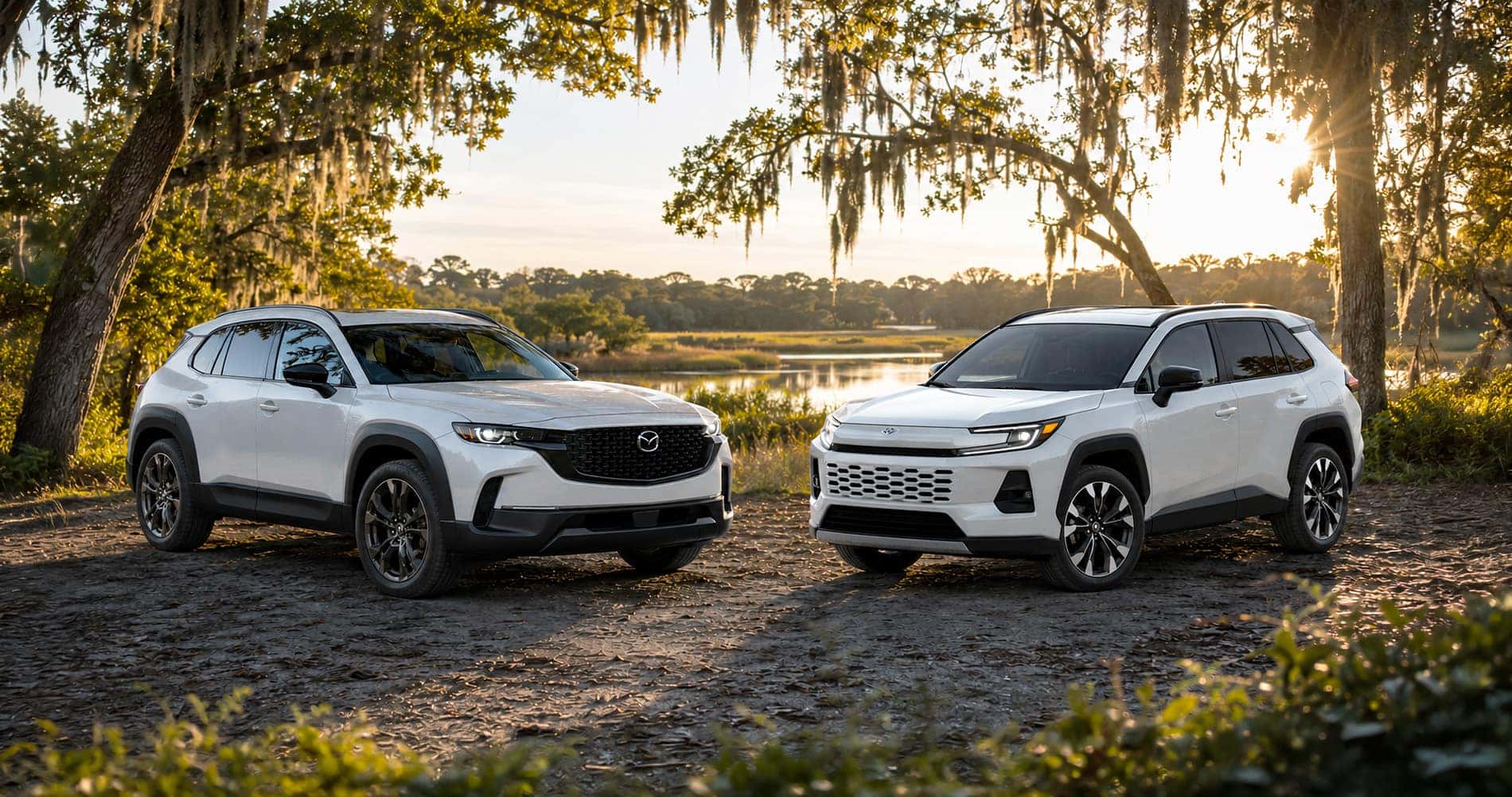
The 2026 Mazda CX-50 Hybrid and 2026 Toyota RAV4 Hybrid bring five-passenger practicality and 2.5-liter hybrid power to the compact-SUV segment, but they emphasize different parts of ownership. The CX-50 Hybrid combines 219 horsepower, standard electric all-wheel drive, 38 combined MPG, a driver-focused cabin, and Mazda’s steering and chassis tuning. The redesigned RAV4 Hybrid counters with higher available output, fuel-economy estimates reaching 43 combined MPG on FWD models, slightly more cargo room, and a broader trim level lineup to choose from.
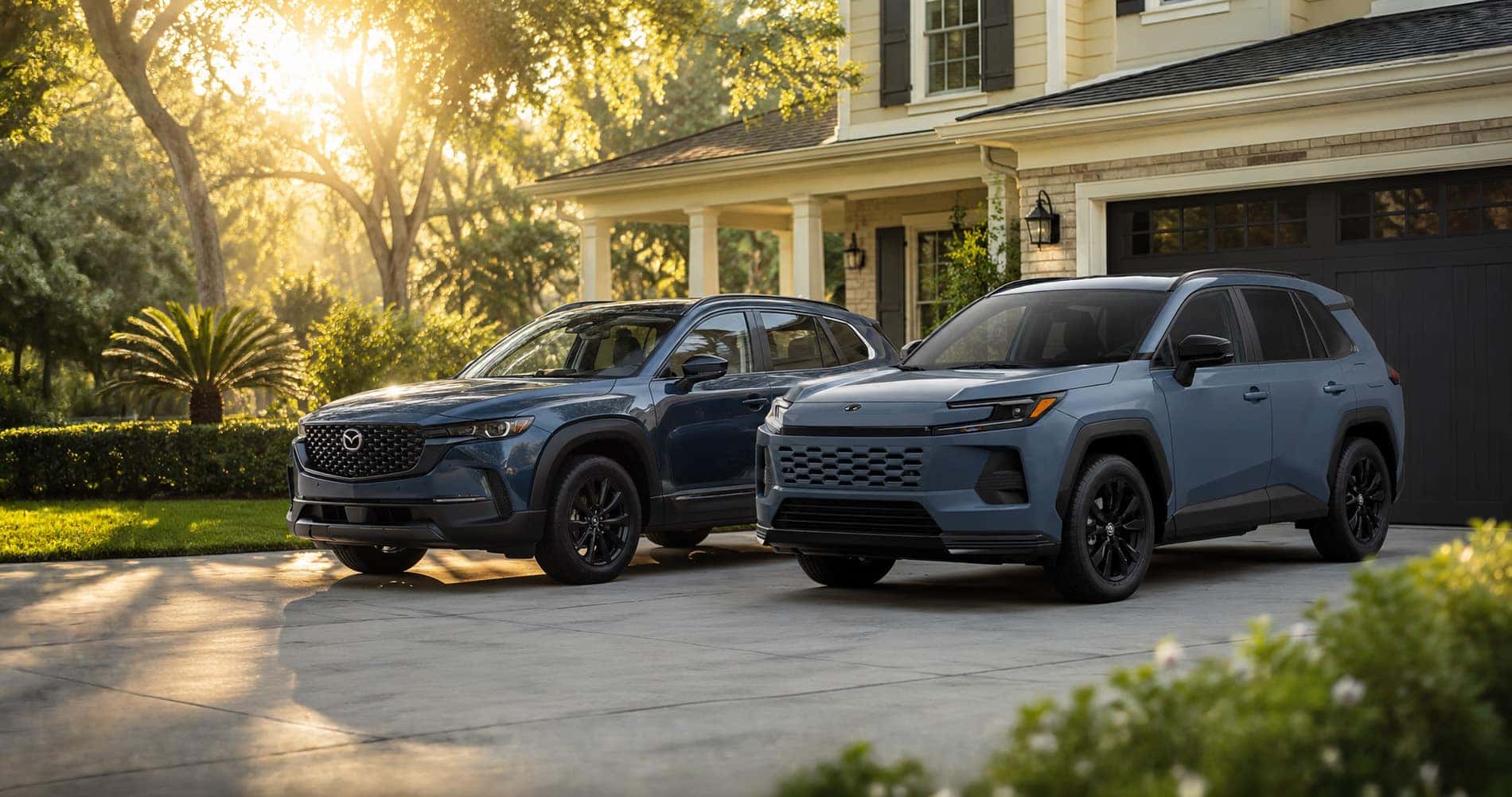
This comparison examines how those differences affect hybrid performance, MPG, AWD operation, driving feel, passenger comfort, cargo capacity, towing, technology, safety features, trims, pricing, and overall buyer fit. Mazda uses Toyota-sourced hybrid hardware, but the CX-50’s wider and longer footprint, seating environment, controls, and chassis calibration produce a distinct everyday experience. For Savannah-area commuting, I-16 and I-95 travel, family errands, and coastal road trips, the decision comes down to whether you value the Toyota’s efficiency and utility ceiling or the Mazda’s standard-AWD simplicity, cabin presentation, and more deliberate road feel.
Quick Answers The essential CX-50 Hybrid vs RAV4 Hybrid differences
▼
Should I choose the CX-50 Hybrid or RAV4 Hybrid? Choose the CX-50 Hybrid when driving character, cabin design, and standard e-AWD matter more than maximum space. Choose the RAV4 Hybrid when higher MPG, more cargo room, broader grade choice, or stronger towing on eligible AWD grades leads the decision.
Which hybrid SUV gets better MPG? RAV4 Hybrid has the higher efficiency ceiling. Front-wheel-drive LE, SE, and XLE Premium models are listed at 47 city, 40 highway, and 43 combined MPG. CX-50 Hybrid is rated at 39 city, 37 highway, and 38 combined MPG.
Which one has more passenger and cargo space? RAV4 Hybrid provides more total passenger volume and substantially more measured cargo room. Both list 37.8 inches of rear legroom, while the CX-50 Hybrid provides more front legroom.
Do both models have AWD? Every CX-50 Hybrid includes electric all-wheel drive. RAV4 Hybrid offers front-wheel drive on LE, SE, and XLE Premium, while Electronic On-Demand AWD is available or standard depending on grade.
Which one can tow more? CX-50 Hybrid is rated to tow up to 1,500 lbs. RAV4 Hybrid towing ranges from 1,750 lbs on selected configurations to 3,500 lbs on eligible AWD grades.
Which one is easier to configure? CX-50 Hybrid keeps the decision simple with three AWD trims and the same MPG rating throughout the lineup. RAV4 Hybrid offers more grades, front- or all-wheel drive, and a wider range of efficiency, equipment, and towing configurations.
Which one should I test-drive first at J.C. Lewis Mazda? Start with the CX-50 Hybrid when seat comfort, steering response, visibility, control placement, and cabin materials could decide the comparison. Those qualities are harder to judge from an MPG or cargo chart.
Core Differences: 2026 CX-50 Hybrid vs 2026 RAV4 Hybrid
Start with the ownership split before comparing every specification. Both SUVs seat five, use 2.5-liter hybrid power, and offer electric rear-axle drive. CX-50 Hybrid packages those ingredients around standard AWD, a more design-led cabin, and Mazda road manners. RAV4 Hybrid uses its redesign to deliver stronger fuel-economy numbers, more interior volume, more grades, and higher towing capability on eligible AWD configurations.
2026 Mazda CX-50 Hybrid vs 2026 Toyota RAV4 Hybrid at a Glance A quick comparison of the differences most likely to affect ownership. Detailed specifications and configuration notes appear in the comparison slider below.
On smaller screens, swipe horizontally to compare. The category column remains visible.
Category
Mazda CX-50 Hybrid
Toyota RAV4 Hybrid
Best For
Driving feel & cabin design
Drivers who want hybrid efficiency, standard AWD, tactile controls, and more deliberate road manners.
Efficiency & practical utility
Commuters and families prioritizing MPG, cargo room, configuration choice, and towing flexibility.
Hybrid Power
219 combined hp / 163 lb‑ft torque
Standard electric AWD.
226 combined hp / 163 lb‑ft torque with FWD 236 combined hp / 184 lb‑ft torque with AWD
Fuel Economy*
39 city / 37 highway / 38 combined MPG
The same estimate across all three hybrid trims.
AWD models range from 38 to 42 combined MPG.
FWD models — up to 47 city / 40 highway / 43 combined MPG
Drivetrain
Electric AWD standard
Included on Preferred, Premium, and Premium Plus.
FWD or Electronic On-Demand AWD
Availability depends on the selected grade.
Passenger & Cargo Use
More front legroom
Equal listed rear legroom, with a lower and wider cabin presentation. Smaller measured cargo hold.
More total passenger volume
Substantially more measured cargo room behind either seating row. Better suited to frequent bulky loads.
Towing*
Up to 1,500 lbs
Suitable for light trailers when properly equipped
Up to 1,750 lbs on FWD configurations
Up to 3,500 lbs on AWD configurations when properly equipped
Cabin & Controls
Design-led and tactile
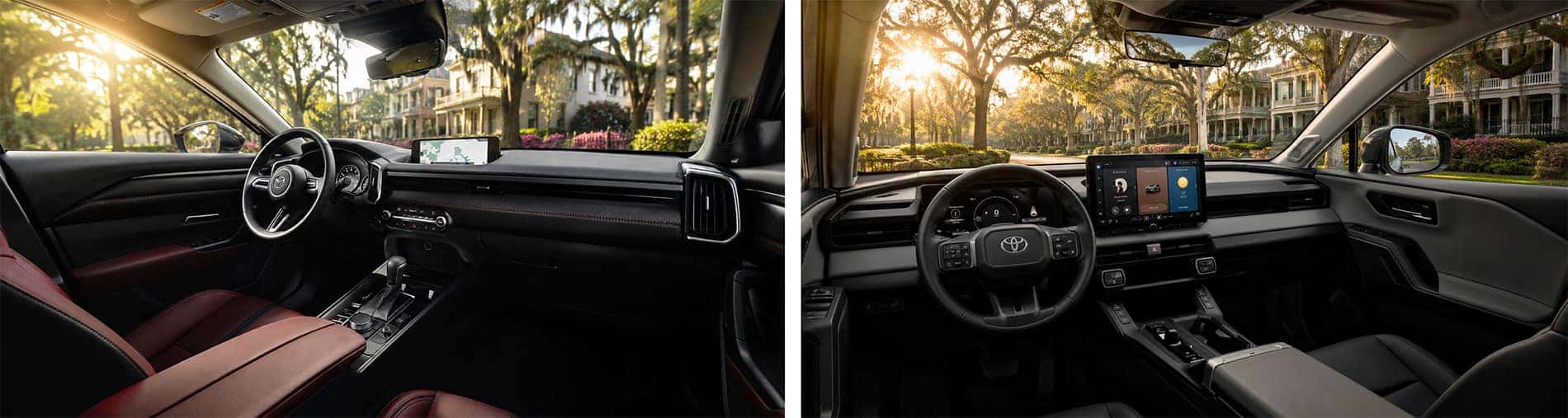
10.25-inch display, physical Commander control, heated front seats, and panoramic moonroof standard.
Upright and screen-focused
Standard 12.3-inch digital gauges and 10.5-inch touchscreen, with a 12.9-inch system on upper grades.
Lineup
Three AWD trims
Preferred, Premium, and Premium Plus create a straightforward comfort-and-technology progression.
Six grades with more configuration paths
LE, SE, XLE Premium, Woodland, XSE, and Limited offer more price, style, drivetrain, and utility choices.
What These Differences Mean
Toyota’s advantages become most valuable when the vehicle regularly carries bulky family gear, accumulates high annual mileage, or needs to tow beyond the Mazda’s limit. Those are recurring ownership demands, not minor chart differences, and they give the RAV4 Hybrid a broader utility ceiling.
Mazda concentrates more of its value in qualities used from the driver’s seat on every trip. Standard e-AWD simplifies the lineup, while the seating position, control layout, steering response, and cabin presentation give the CX-50 Hybrid a more distinctive daily character. A test drive matters because those strengths cannot be measured by cargo or MPG figures alone.
Independent Review Context
How the CX-50 Hybrid and RAV4 Hybrid Feel Beyond the Numbers
Specifications explain what each SUV can do. Reviews help clarify how the cabin, controls, powertrain, ride, and handling come together during everyday driving. Car and Driver currently rates both models 8.5 out of 10, but for different reasons.
Car and Driver: 8.5/10
2026 Mazda CX-50 Hybrid
What stands out
The review highlights the CX-50 Hybrid’s enjoyable road manners, upscale-feeling cabin, and substantial efficiency improvement over the gas-powered CX-50.
What to consider
The e-CVT can sound strained during harder acceleration, and rear-seat and cargo space are less generous than in some hybrid competitors.
Shopping meaning: The Mazda makes the strongest case when the front-seat environment, steering response, and sense of control matter more than maximizing interior volume.
The review emphasizes smooth hybrid performance, strong fuel economy, useful passenger and cargo space, responsive acceleration, and a broad feature list.
What to consider
Some cabin materials feel less refined, the handling is more functional than engaging, and the engine can become noticeable under heavier load.
Shopping meaning: The Toyota makes the strongest case when fuel economy, cargo flexibility, and broad everyday usefulness carry more weight than steering feel or cabin presentation.
You want the more design-focused cabin, more deliberate steering and body control, and a consistent standard-AWD experience.
Lean toward the RAV4 Hybrid when…
You want the higher efficiency ceiling of the front-wheel drive models, additional cargo capacity, and more configuration choices to choose from.
An identical editorial score does not indicate an identical ownership experience. Use the reviews to identify what deserves closer attention during a test drive, then let your daily priorities determine which strengths matter more.
Compare CX-50 Hybrid & RAV4 Hybrid by What Matters Most
Choose a topic to compare hybrid power, MPG, AWD operation, road manners, passenger room, cargo, towing, technology, safety features, standard equipment, pricing, and buyer fit.
Select a Topic
Select a topic to update the comparison. On smaller screens, swipe the topic row and each table horizontally.
Comparison Topic 1 of 7
Hybrid System, Power & Performance
System output, transmission behavior, drivetrain choice, and how the powertrains approach everyday response
Manufacturer specifications are shown for the standard hybrid models. Combined hybrid-system torque is not published on a directly comparable basis.
Category
Mazda CX-50 Hybrid
Toyota RAV4 Hybrid
Engine & Hybrid System
2.5-liter four-cylinder hybrid system
Front and rear electric motors with standard electric AWD.
Toyota-partnered hybrid hardware integrated into the CX-50.
2.5-liter Dynamic Force four-cylinder hybrid system
Hybrid motor-generators support front-wheel-drive or Electronic On-Demand AWD layouts.
Combined Output
219 combined hp / 163 lb‑ft torque
One output rating across all three hybrid trims.
226 combined hp / 163 lb‑ft torque with FWD 236 combined hp / 184 lb‑ft torque with AWD
Transmission
Electronically controlled e-CVT
Tuned for smooth hybrid operation rather than simulated conventional shifts.
Electronically controlled e-CVT with sequential shift mode
Transmission operation is shared across the hybrid grade lineup.
Drivetrain Choice
Electric AWD standard
Included on Preferred, Premium, and Premium Plus.
FWD or Electronic On-Demand AWD
Availability depends on the selected grade.
Power & Performance Takeaway
Toyota has the stronger output number, while Mazda makes its case through the way the vehicle responds to steering and road inputs. The CX-50 Hybrid does not turn the shared hybrid concept into a sports SUV, but it keeps more of a driver-focused personality around the powertrain.
Comparison Topic 2 of 7
MPG & Daily Efficiency
City, highway, and combined estimates, fuel capacity, drivetrain effects, and high-mileage ownership meaning
MPG figures are EPA or manufacturer estimates. Actual mileage varies with speed, traffic, weather, loading, tires, maintenance, and other conditions.
Category
Mazda CX-50 Hybrid
Toyota RAV4 Hybrid
EPA Efficiency Ratings*
39 city / 37 highway 38 combined MPG
47 / 40 / 43 MPG LE, SE, and XLE Premium FWD
46 / 39 / 42 MPG LE and SE AWD
38–41 combined MPG Other AWD grades
Fuel Tank
14.5 gallons
14.5 gallons
Configuration Effect
One MPG rating across the lineup All three trims include AWD without changing the estimate.
Efficiency varies by drivetrain and grade FWD provides the highest estimates; AWD, wheels, tires, and utility equipment affect the result.
High-Mileage Use
Strong efficiency with AWD included A straightforward fit for mixed Savannah-area commuting and highway travel.
Higher fuel-economy ceiling The stronger fit when minimizing fuel use across high annual mileage leads the decision.
Efficiency Takeaway
RAV4 Hybrid is the stronger answer for shoppers who rank MPG first. CX-50 Hybrid still delivers a meaningful efficiency benefit while making AWD standard. The important tradeoff is whether the Toyota’s extra miles per gallon matter more than the Mazda’s cabin and road feel.
Comparison Topic 3 of 7
AWD, Driving Feel & Road Manners
Electric rear-axle drive, chassis design, ground clearance, footprint, wheels, and driver-selectable modes
AWD, drive modes, tires, and ground-clearance figures do not guarantee traction or capability. Weather, surface conditions, loading, maintenance, and driver decisions remain critical.
Category
Mazda CX-50 Hybrid
Toyota RAV4 Hybrid
AWD Operation
Electric AWD standard A dedicated rear motor supplies rear-axle drive when the system calls for it.
Electronic On-Demand AWD available or standard A rear motor supports AWD models, while FWD remains available on three grades.
Suspension
MacPherson strut front Torsion-beam rear
MacPherson strut front Multi-link rear
Size & Wheelbase
110.8-in. wheelbase 186.1 in. long 75.6 in. wide Longer and wider, with a more planted visual stance.
105.9-in. wheelbase 181.0 in. long 73.0 in. wide on most grades Smaller footprint can help in tighter parking areas.
Ground Clearance
7.8 in. Hybrid Preferred and Premium
8.1 in. Hybrid Premium Plus
8.1 in. Most grades
8.5 in. Woodland
Wheels & Tires
17-inch wheels Preferred and Premium
19-inch wheels Premium Plus
17-, 18-, or 20-inch wheels Varies by grade
Woodland adds 18-inch all-terrain tires.
Drive Controls
EV mode Mi-Drive Power mode Mi-Drive Trail mode
EV mode Additional drive controls vary by grade and drivetrain.
AWD & Driving Takeaway
Mazda makes AWD part of every hybrid and tunes the surrounding vehicle for a more deliberate road feel. Toyota gives shoppers more drivetrain choice and a smaller footprint. The RAV4 is easier to justify for efficiency and utility; the CX-50 is easier to justify when the way the SUV feels from the driver’s seat carries more weight.
Comparison Topic 4 of 7
Passenger Space, Seating & Daily Comfort
Passenger measurements, seating equipment, and the space-versus-environment tradeoff
Interior measurements can vary by trim, seat position, and manufacturer methodology. Compare the exact vehicles in person when passenger comfort is important.
Category
Mazda CX-50 Hybrid
Toyota RAV4 Hybrid
Passenger Volume
97.0 cu. ft.
98.9 cu. ft.
Legroom
Front: 41.7 in. Rear: 37.8 in. More front legroom; rear measurement is a draw.
Front: 41.0 in. Rear: 37.8 in. Same listed rear legroom with more total passenger volume.
Seat Equipment
Heated front seats standard 8-way power driver’s seat standard
Premium adds leather, ventilation, driver memory, and a power passenger seat.
Equipment varies more by grade Heated front seats begin on selected mid grades, while ventilation and heated rear seats are offered higher in the lineup.
Passenger-Space Takeaway
Rear legroom is a draw, not a Toyota advantage. RAV4 Hybrid provides more total passenger volume, while CX-50 Hybrid gives the driver more front legroom and a more carefully styled environment. Sit in both rows before letting one measurement decide the purchase.
Comparison Topic 5 of 7
Cargo, Towing & Weekend Utility
Cargo volume, towing configurations, liftgate equipment, roof utility, and the practical limits behind the numbers
Maximum towing requires the correct configuration, hitch, equipment, loading, tongue weight, trailer brakes where applicable, and owner’s manual guidance.
Category
Mazda CX-50 Hybrid
Toyota RAV4 Hybrid
Cargo Volume
29.2 cu. ft. Behind the rear seat
56.3 cu. ft. With the rear seat folded
37.8 cu. ft. Behind the rear seat
70.4 cu. ft. With the rear seat folded
Maximum Towing*
1,500 lbs When properly equipped
1,750 lbs LE FWD/AWD, SE FWD, and XLE Premium FWD
3,500 lbs SE AWD, XLE Premium AWD, Woodland, XSE AWD, and Limited AWD
Cargo Access
Power liftgate standard Wide, low cargo layout with remote rear-seat releases and programmable opening height.
Larger measured cargo hold Power-liftgate availability varies by grade and package.
Roof & Exterior Utility
Roof rails standard Black roof rails on Premium and Premium Plus; crossbars and attachments are accessories.
Low-profile rails on most grades Woodland adds raised rails with crossbars, a tow hitch, and all-terrain tires.
Cargo & Towing Takeaway
Toyota wins the measured utility comparison by a meaningful margin. The cargo difference can affect strollers, coolers, luggage, pet gear, and folded-seat loads, while eligible RAV4 AWD grades more than double the Mazda’s towing rating. CX-50 Hybrid remains useful for everyday gear and light trailers, but its strongest case lies elsewhere.
Comparison Topic 6 of 7
Interior, Technology & Safety Features
Display strategy, audio, connectivity, driver assistance, parking support, and everyday control design
Feature availability varies by trim, package, subscription, connected-service enrollment, device compatibility, and production changes. Verify the exact window sticker.
Category
Mazda CX-50 Hybrid
Toyota RAV4 Hybrid
Displays
10.25-in. center display 7-in. TFT meter display Active Driving Display on Premium Plus
10.5-in. center touchscreen standard 12.9-in. system on XSE and Limited 12.3-in. digital gauge cluster standard
Phone & Charging
Wireless Apple CarPlay & Android Auto Wireless charging Four USB-C ports Alexa Built-in
Wireless Apple CarPlay & Android Auto Available wireless charging Connected features depend on service and enrollment
Audio
8-speaker system standard 12-speaker Bose audio on Premium and Premium Plus
6-speaker system standard 9-speaker JBL system standard on Limited and available on XSE
Driver Assistance
Mazda i-Activsense • Radar cruise control with Stop & Go • Smart Brake Support • Lane departure warning and lane keeping • Blind Spot Monitoring • Rear Cross Traffic Alert
Toyota Safety Sense 4.0 • Adaptive cruise control • Automatic braking support • Lane assistance • Blind Spot Monitor • Rear Cross-Traffic Alert
Parking Support
Front and rear parking sensors Listed across the hybrid lineup.
Grade-dependent parking support Front and Rear Parking Assist with Automatic Braking begins on selected grades; Panoramic View Monitor is offered higher in the lineup.
Control Approach
Physical Commander control Common functions can be managed without relying entirely on touchscreen input.
Touchscreen-centered interface Larger displays and configurable digital menus place more functions inside the multimedia system.
Technology Takeaway
Toyota emphasizes larger digital displays and a newer multimedia platform. Mazda emphasizes consistent wireless connectivity and tactile controls. The better system depends on how you prefer to interact with the vehicle during everyday driving.
Comparison Topic 7 of 7
Trims, Standard Equipment, Pricing & Buyer Fit
Three Mazda trims versus six Toyota grades, with pricing and equipment interpreted around the shopper decision
Base MSRP excludes destination or delivery, processing and handling, taxes, title, license, options, accessories, and dealer charges. Regional Toyota delivery fees can vary.
Category
Mazda CX-50 Hybrid
Toyota RAV4 Hybrid
Entry Point
Hybrid Preferred: $34,750 MSRP* • Standard e-AWD • 38 combined MPG • Heated front seats • 10.25-in. display • Wireless charging • Power liftgate • Panoramic moonroof
LE FWD: $31,900 MSRP • 43 combined MPG • 12.3-in. digital gauges • 10.5-in. multimedia • Toyota Safety Sense 4.0
Three AWD-only trims Choose how much seating comfort, audio, display technology, and upper-trim equipment you want. Drivetrain and MPG remain consistent.
Six grades with FWD and AWD paths Choose by efficiency target, drivetrain, styling, towing need, equipment, and budget.
Trim & Value Takeaway
Mazda offers the simpler shopping process and a richer standard comfort baseline. Toyota offers the lower entry price and far more ways to configure the vehicle. CX-50 Hybrid Preferred is the natural Mazda starting point; RAV4 shoppers need to decide whether FWD efficiency, AWD towing, Woodland utility, XSE style, or Limited equipment matters most.
Which Hybrid Compact SUV Fits Your Routine?
The better choice comes from identifying which advantages will affect a normal week rather than choosing by one MPG, horsepower, or cargo figure.
Driving Character
Choose CX-50 Hybrid for the Road Feel
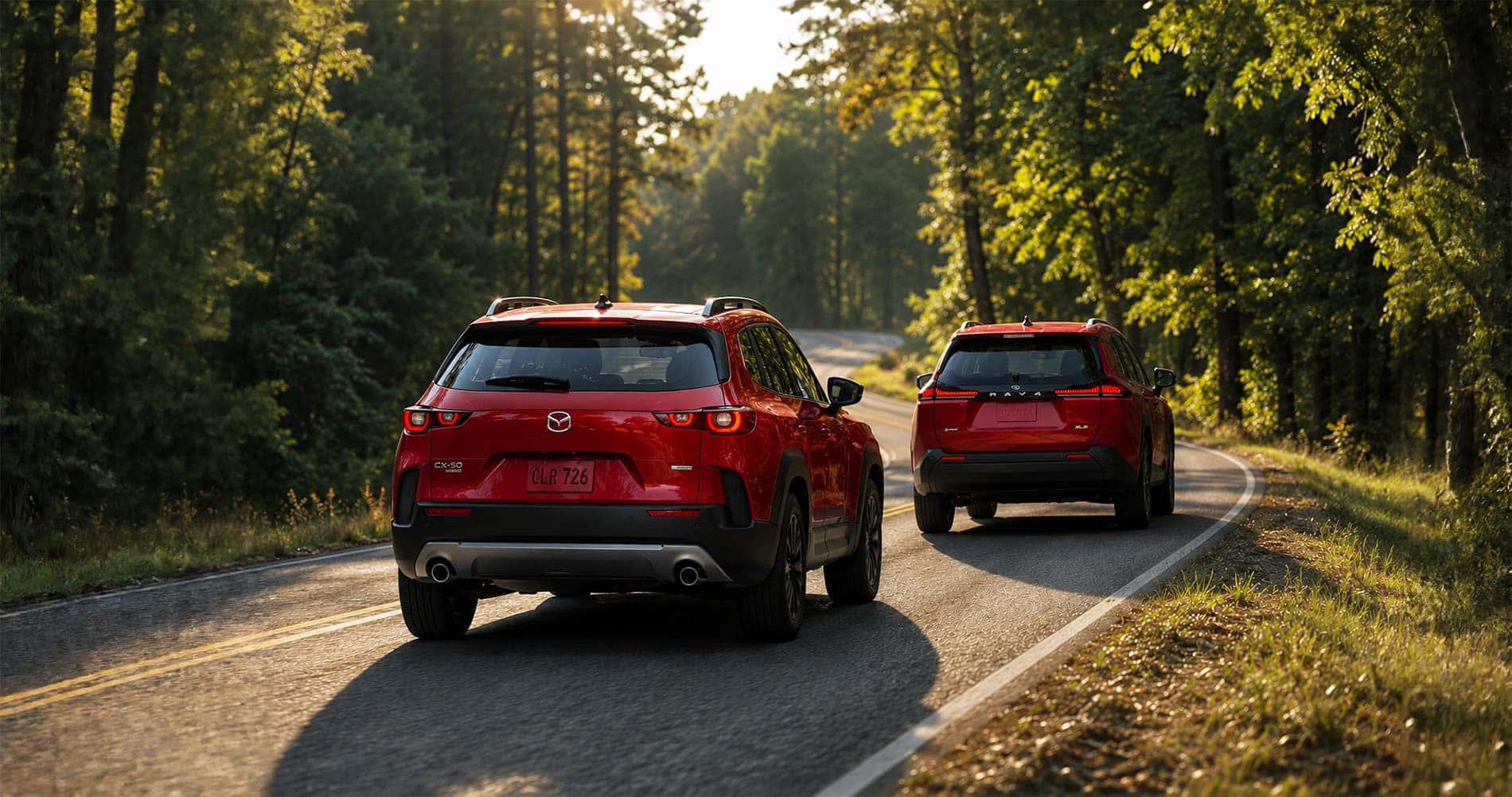
The Mazda fits drivers who notice steering weight, body response, seating position, and control placement. Its 219-hp system is not the most powerful in the comparison, but the surrounding chassis gives the SUV a more deliberate personality during commuting, ramps, curves, and long highway stretches.
Maximum Efficiency
Choose RAV4 Hybrid for Slightly Higher MPG
The Toyota fits high-mileage commuters and fuel-economy-first shoppers. Its most efficient front-wheel-drive grades reach 43 combined MPG, and several AWD configurations also exceed the Mazda’s combined estimate. That advantage becomes more valuable as annual mileage rises.
Premium-Feeling Daily Use
Choose CX-50 Hybrid for Cabin Design
The CX-50 Hybrid fits shoppers who spend more time noticing the front-seat environment than maximizing the cargo chart. Its seating position, materials, physical controls, and consistent comfort baseline create a more polished everyday setting, while the upper trims add features without changing the drivetrain or fuel-economy decision.
Space & Practical Utility
Choose RAV4 Hybrid for Cargo and Towing
RAV4 Hybrid is the stronger family-and-gear choice when the cargo area stays busy or a trailer is part of the plan. Its larger measured cargo hold and higher-capacity eligible AWD configurations give it more room to absorb changing family, recreation, and utility needs.
Interactive Hybrid SUV Finder
Should You Choose the CX-50 Hybrid or RAV4 Hybrid?
Answer six questions to see whether the Mazda, Toyota, or both SUVs deserve a closer look based on mileage, cabin priorities, passenger and cargo use, towing, AWD strategy, and the way you prefer to shop a trim lineup.
Quiz results are general shopping guidance only. Final fit depends on exact equipment, pricing, MPG priorities, passenger use, cargo, towing, inventory, and your specific driving routine.
Compare the Everyday Experience
Explore the 2026 CX-50 Hybrid at J.C. Lewis Mazda
An in-person drive can clarify the differences that specifications cannot: seat comfort, steering response, visibility, control layout, hybrid behavior, road noise, ride quality, and how naturally the cargo area fits your routine.
RAV4 Hybrid remains the stronger specification fit when maximum fuel economy, cargo flexibility, configuration variety, or higher‑capacity eligible towing leads the decision. Its broad lineup gives shoppers more ways to balance drivetrain, equipment, efficiency, and utility, making it the more adaptable choice for drivers who prioritize measurable capability or need their SUV to cover a wide range of tasks.
CX‑50 Hybrid is the better starting point when standard AWD, cabin design, steering feel, and a consistent comfort baseline matter more than maximum volume. Mazda’s focus on driving engagement, interior refinement, and cohesive trim strategy creates a daily experience that feels more intentional and more premium, especially for shoppers who value how an SUV feels from behind the wheel as much as what it can carry.
The final decision isn’t about which SUV “wins” every category. It’s about which strengths align more naturally with the way the vehicle will actually be used. If your priorities lean toward efficiency, versatility, and broad configuration choice, the Toyota’s practical ceiling is hard to ignore. If your priorities lean toward driving enjoyment, interior quality, and a more unified trim experience, the Mazda’s everyday consistency becomes the more compelling fit.
FAQ: 2026 Mazda CX-50 Hybrid vs Toyota RAV4 Hybrid
Does the Mazda CX-50 Hybrid use a Toyota hybrid system? ▼
Yes. The CX-50 Hybrid uses Toyota-sourced 2.5-liter hybrid hardware, including an e-CVT and electric rear-axle drive. Mazda integrates that system into the CX-50 body and applies its own steering, suspension, seating, control, and trim strategy. The redesigned 2026 RAV4 uses a newer-generation Toyota hybrid system, so the powertrains are related rather than identical.
Which CX-50 Hybrid trim is the best value? ▼
Hybrid Preferred is the strongest starting point for many shoppers because it includes the 219-hp hybrid system, standard e-AWD, 38 combined MPG, heated front seats, a 10.25-inch display, wireless phone charging, a power liftgate, and a panoramic moonroof. Premium and Premium Plus make sense when leather, ventilation, Bose audio, memory, a head-up display, or heated rear seats justify the step up.
Is the CX-50 Hybrid a good commuter SUV? ▼
Yes. It combines 38 combined MPG with standard AWD, supportive front seating, a polished cabin, and composed highway manners. RAV4 Hybrid is the better commuter when the highest possible MPG matters more than the Mazda driving environment.
Is the RAV4 Hybrid better for families? ▼
RAV4 Hybrid is the stronger family fit when cargo volume, total passenger space, and configuration choice lead the decision. CX-50 Hybrid remains a credible five-passenger option for households that prioritize front-cabin design and driving character over maximum cargo capacity.
Which SUV is easier to place in tight parking areas? ▼
RAV4 Hybrid has the smaller exterior footprint on most grades, measuring about five inches shorter and more than two inches narrower than the CX-50 Hybrid. That can make the Toyota easier to place in tighter parking structures and crowded lots, although visibility, camera equipment, wheel size, and driver familiarity also matter.
Is the CX-50 Hybrid suitable for light towing? ▼
Yes. The CX-50 Hybrid is rated to tow up to 1,500 lbs when properly equipped, which can support selected light trailers and recreational loads. Confirm the trailer’s loaded weight, tongue weight, hitch, wiring, passenger and cargo load, and all owner’s manual requirements before towing.
What should I compare during a test drive? ▼
Compare seat comfort, visibility, steering response, ride quality, road and engine noise, hybrid response, control placement, screen operation, rear-seat access, and cargo loading. Also verify the exact trim equipment and price rather than assuming two vehicles with similar specifications will feel the same.
What areas does J.C. Lewis Mazda serve? ▼
J.C. Lewis Mazda serves shoppers from Savannah, Pooler, Richmond Hill, Statesboro, Brunswick, Hilton Head, Bluffton, and Beaufort, along with drivers throughout Coastal Georgia and the South Carolina Lowcountry.
CX‑50 Hybrid Shopping Support at J.C. Lewis Mazda
At J.C. Lewis Mazda, our team can help you compare CX‑50 Hybrid Preferred, Premium, and Premium Plus equipment around the way you actually drive. An in-person evaluation can clarify seating comfort, visibility, control placement, steering response, rear-seat access, and cargo usability before you decide which trim fits your routine.
Our online tools make it easier to review current Mazda inventory, estimate a trade value, explore financing, and plan a payment before visiting the dealership. We can also help you compare exact equipment and current pricing rather than relying only on base-model specifications.
J.C. Lewis Mazda supports drivers from Savannah and surrounding Coastal Georgia and Lowcountry communities with vehicle shopping, test-drive guidance, financing assistance, and long-term Mazda service and parts support. The goal is a clearer decision now and a convenient ownership relationship after the sale.
Where To Go Next
Keep researching through J.C. Lewis Mazda’s comparison resources, then move into current inventory, financing, payment planning, trade value, or direct dealership support.
Disclaimers:
*MSRP figures are manufacturer suggested retail prices and exclude taxes, title, license, registration, optional equipment, accessories, dealer-installed items, and dealer charges. Mazda lists a $1,495 destination charge for the continental United States. Toyota delivery, processing and handling is separate and can vary by region. Dealer pricing, incentives, and inventory change regularly.
*MPG figures are EPA or manufacturer estimates. Actual mileage varies with driving style, speed, traffic, weather, temperature, loading, tire pressure, maintenance, fuel, vehicle condition, and other factors.
*Horsepower and torque figures use each manufacturer’s published methodology. Engine-only and individual electric-motor torque figures are not the same as combined hybrid-system torque.
*Maximum towing requires the correct vehicle configuration, hitch, wiring, trailer equipment, loading, tongue weight, trailer brakes where applicable, operating conditions, and owner’s manual guidance. Passengers and cargo reduce available capacity. Never exceed any vehicle, axle, hitch, trailer, or tire rating.
*Cargo, passenger, dimensional, ground-clearance, and seating measurements can use different manufacturer methods and can vary with trim, seat position, accessories, tires, and loading.
*AWD, drive modes, clearance, all-terrain tires, traction controls, and driver-assistance systems do not eliminate the limits of traction or vehicle capability. They do not replace attentive driving, appropriate tires, safe speeds, or sound judgment.
*Trim content, features, connected services, trials, subscriptions, colors, packages, pricing, and availability are subject to change. Verify the exact window sticker and current manufacturer and dealership information before purchase.
*Mazda i-Activsense, Toyota Safety Sense, parking systems, blind-spot systems, braking support, and other driver-assistance features have operational limits and are not substitutes for safe, attentive driving.
*Car and Driver ratings and editorial conclusions are third-party opinions and were reviewed July 21, 2026. Ratings, rankings, and review content can change.