

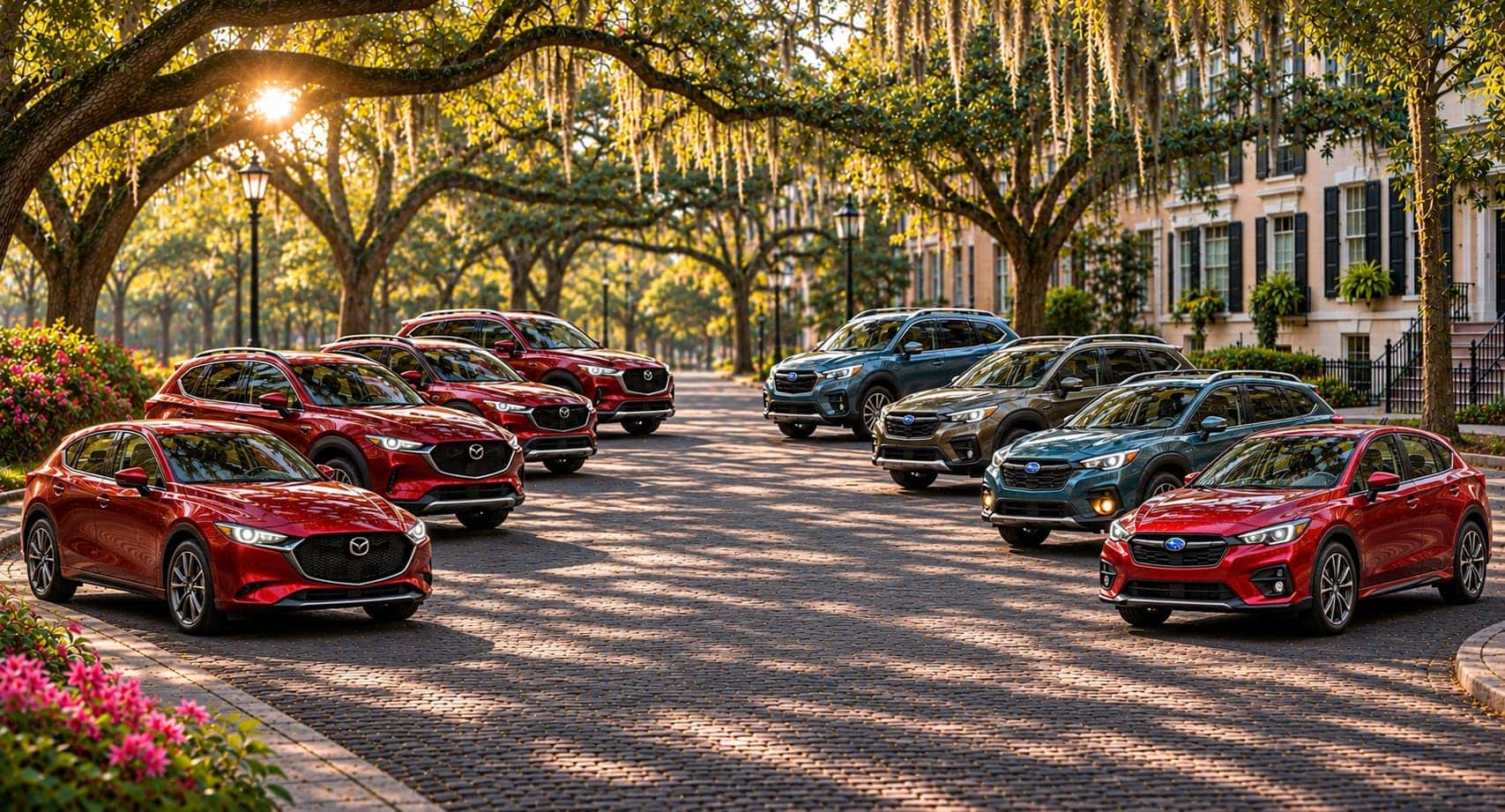
Mazda cars and SUVs facing Subaru cars and SUVs on a historic cobblestone street beneath oak trees in Savannah, GA

AWD SUVs for Savannah & the Lowcountry

Mazda vs Subaru

What Matters Beyond AWD for Savannah Drivers?

Mazda and Subaru both make everyday SUVs with all-wheel drive. The bigger choice is how you want the vehicle to feel, what you carry, and whether your next step is gasoline, hybrid, plug-in hybrid, or electric.


A comfortable commute and room for a weekend’s gear put Mazda and Subaru on many of the same shopping lists. A week around Savannah can move from Abercorn Street errands to a Pooler commute and a day at the coast. Both brands build SUVs suited to that mix, which makes their differences worth exploring beyond the AWD badge.

The useful comparison starts with how an SUV fits your life: how easily passengers settle in, how the cabin feels on a familiar road, what you can carry with the seats in use, and how the controls work after the first few minutes. Hybrid, plug-in-hybrid, and electric choices add another ownership question: how you want to refuel or recharge. You can weigh those priorities before choosing a particular model.

At J.C. Lewis Mazda, we use this guide to help you decide which differences deserve a closer look before you choose a vehicle. Start with your priorities below, then explore the SUV shopping pairs, AWD systems, electrified options, and ownership questions. Our existing model comparisons handle the detailed head-to-head specifications when you are ready to narrow the list.

Your Everyday Priorities

Which Part of Your Week Should Shape the Shortlist?

Choose the priority that matters most in your next SUV. Each result suggests a first look and a useful alternative to compare.

Based on Your Priority

You Want to Enjoy the Drive, Even on an Ordinary Day

Start with Mazda — CX-50 First

Why It Fits

CX-50 gives you a useful first drive when steering response, cabin layout, and the way an SUV feels from the driver’s seat matter. Try its seating position and controls on a route you know; the details you notice repeatedly deserve weight in the decision.

Also Compare

Forester is worth a look if outward visibility and passenger access lead your priorities. Compare the cabins with your usual passengers aboard so the driver’s preference and everyone else’s comfort stay part of the same decision.

Based on Your Priority

You Want an SUV That Fits Your Everyday Parking

Start with Mazda — CX-30 First

Why It Fits

CX-30 is Mazda’s smallest SUV and includes standard AWD. Its compact proportions make it a sensible first look when maneuvering and parking matter every day. Check that its rear seat and cargo area still handle what you regularly carry.

Also Compare

Crosstrek is the natural Subaru alternative. Compare rear-seat access and usable luggage space in person; the smaller SUV you enjoy driving still needs to accommodate the people and gear coming with you.

Based on Your Priority

Rough Access Roads Are a Regular Part of Your Plans

Start with Subaru — Explore Wilderness

Why It Fits

Wilderness versions of Crosstrek, Forester, and Outback add model-specific clearance, all-terrain tires, and trail equipment. Those upgrades give Subaru a focused place to start when uneven access roads are a regular use rather than an occasional possibility.

Also Compare

CX-50 Meridian editions provide an outdoor-oriented Mazda alternative. Compare the specific tires and equipment alongside ride comfort and road response, especially if most of your driving still takes place on pavement.

Based on Your Priority

You Want Hybrid Power without a Charging Commitment

Keep Both Brands on the List — Start with CX-50 Hybrid

Why It Fits

CX-50 Hybrid, Forester Hybrid, and Crosstrek Hybrid are full hybrids that do not require external charging. All include AWD, so a charger is not what separates these choices. Cabin fit, vehicle size, and the way the hybrid responds deserve the next comparison.

Also Compare

Begin with CX-50 Hybrid and Forester Hybrid for compact-SUV shopping. Add Crosstrek Hybrid if a smaller crossover suits your needs. Try the rear seat and load your usual bags before deciding which size works best.

Based on Your Priority

You Need Three Rows & Plug-In Hybrid Power

Start with Mazda — CX-90 PHEV First

Why It Fits

CX-90 PHEV combines three-row seating with a rechargeable hybrid system and a gasoline engine. It is a clear Mazda starting point for a household that can charge regularly and wants gasoline flexibility for longer travel.

Also Compare

Ascent is Subaru’s three-row SUV alternative, with gasoline power. It is relevant when seating and family travel come first; it does not provide a current plug-in-hybrid equivalent.

Based on Your Priority

You Want an SUV Powered Entirely by Electricity

Start with Subaru’s EV Lineup

Why It Fits

Solterra, Trailseeker, and Uncharted give Subaru a battery-electric SUV range. Start here between these two brands when having no gasoline engine is a firm requirement. Mazda’s current U.S. lineup does not offer a battery-electric vehicle.

Also Compare

A Mazda PHEV is relevant if you want external charging with a gasoline backup. It serves a different powertrain preference, so consider it only if retaining an engine fits your plans.

Mazda vs Subaru in 60 SecondsSix Answers before You Choose a Model

Is AWD Standard on Both Brands’ SUVs?
Mazda’s current SUVs include standard AWD; CX-50 Hybrid uses e-AWD. Subaru’s gasoline and hybrid SUVs also include standard Symmetrical AWD. The electric Uncharted Premium FWD is an exception.


Which SUVs Should You Cross-Shop First?
Compare CX-30 with Crosstrek for smaller crossovers, CX-5 with Forester for everyday compact-SUV use, and CX-50 with Outback for outdoor versatility. CX-90 and Ascent serve three-row households. Check passenger and cargo space in each pair; their dimensions differ.


Which Hybrid SUVs Does Each Brand Offer?
Mazda CX-50 Hybrid, Subaru Forester Hybrid, and Subaru Crosstrek Hybrid require no external charging. Mazda also offers the outgoing 2026 CX-70 PHEV and the 2027 CX-90 PHEV for plug-in-hybrid shoppers. Subaru’s current new U.S. lineup has no plug-in hybrid.


Which Brand Offers Fully Electric SUVs?
Subaru offers Solterra, Trailseeker, and Uncharted. Mazda’s current U.S. lineup has no fully electric SUV. Its PHEVs combine external charging with a gasoline engine, so they serve a different ownership preference.


What Separates Their Outdoor-Oriented Versions?
Subaru’s Wilderness models add raised suspension, all-terrain tires, and model-specific trail equipment. Mazda’s CX-50 Turbo Meridian Edition also has all-terrain tires. Compare clearance and equipment on the exact trims; an outdoor badge alone does not establish equal capability.


Are Their Basic Warranty Durations Different?
No. Both provide 3-year/36,000-mile basic or new-vehicle limited coverage and 5-year/60,000-mile powertrain limited coverage, whichever comes first. Matching durations do not mean identical coverage; compare covered components, exclusions, and any separate hybrid or EV warranties.
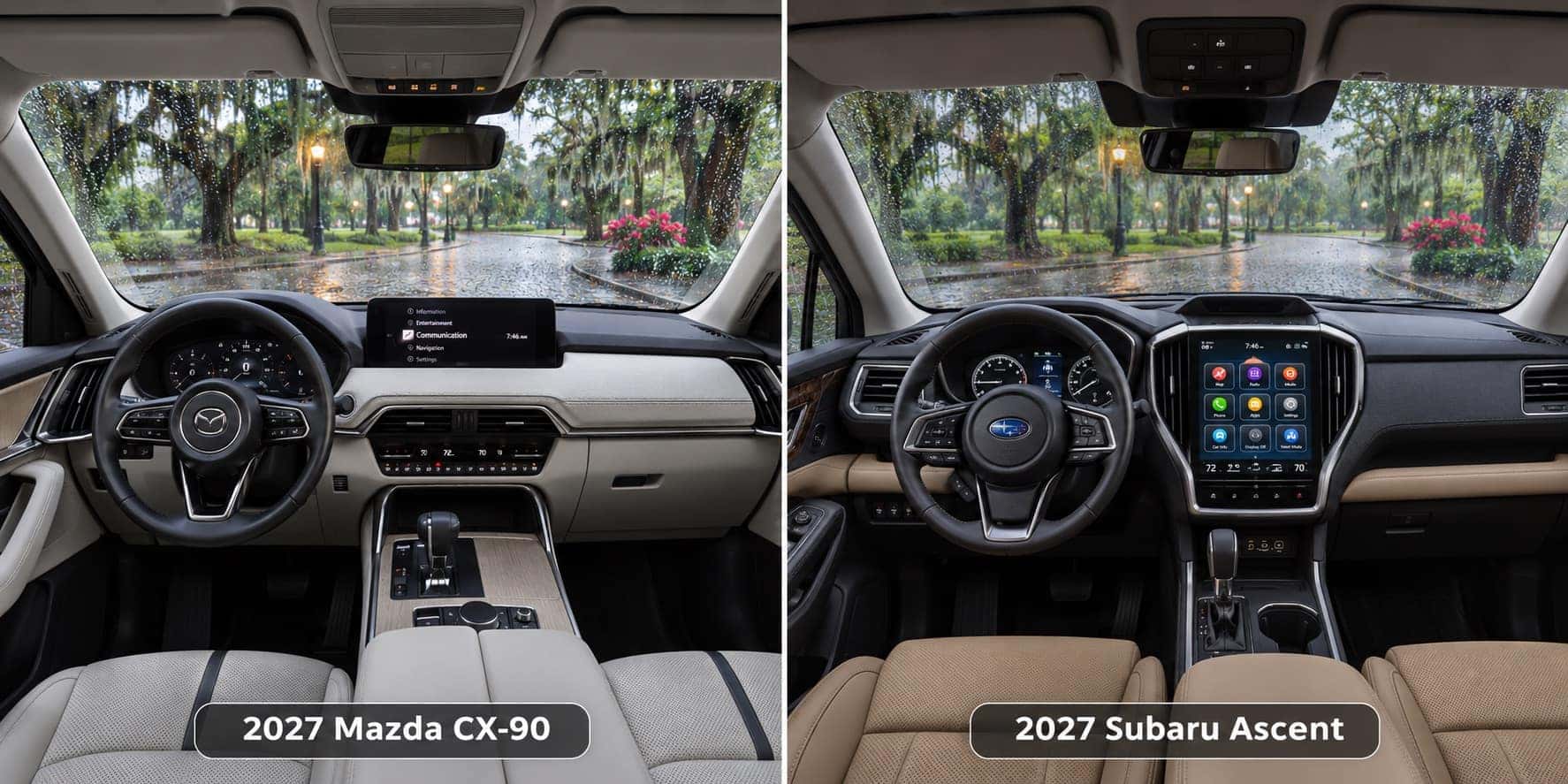
2027 Mazda CX-90 and 2027 Subaru Ascent interiors shown side by side with contrasting cabin designs on a rainy morning in Savannah, GA

How Do Mazda & Subaru Approach the Same SUV Needs?

Start with the roles each brand fills, then compare how AWD, electrification, cabin design and ownership costs affect your everyday driving. The model examples make the differences concrete without pretending every SUV is an exact counterpart.

Start With the Big Brand Difference; Then Compare by Priority


At a Glance

Two AWD SUV Lineups with Different Reasons to Choose Them

The overlap is strongest in small and family SUVs. Mazda adds a distinctive road feel and current plug-in SUV choices; Subaru adds a broader Wilderness family and fully electric SUVs.

The Brand Choices That Shape Your Shortlist
Decision Point Mazda Subaru
SUV Range • CX-30, CX-5, CX-50 and CX-90
• From compact daily use to larger two- or three-row needs; selected 2027 CX-90 inline-six trims offer a two-row configuration.
• Crosstrek, Forester, Outback and Ascent
• Covers small to three-row SUVs, with battery-electric choices for shoppers who want no gasoline engine.
AWD Availability • Standard Across Current Mazda SUVs
• The CX-50 Hybrid uses electronic AWD; compare tires and vehicle response, not only the AWD badge.
• Standard on Core Gas and Hybrid SUVs
• Symmetrical AWD is a hallmark, but the Uncharted Premium FWD is an electric-SUV exception.
Everyday Appeal • Steering Feel and Cabin Presentation
• Consider Mazda when driving position, control layout and road response are part of the daily reward.
• Visibility, Space and Outdoor Versatility
• Consider Subaru when easy passenger access, an airy view or specialized rough-road equipment matters more.
Full Hybrid (No Plug) • CX-50 Hybrid
• Electronic AWD and gasoline-electric driving without a charging routine; one compact-SUV hybrid route.
• Forester Hybrid and Crosstrek Hybrid
• Two no-plug AWD choices in different sizes, balancing passenger-room and compact-parking priorities.
External-Charging Choices • 2027 CX-90 PHEV and Outgoing 2026 CX-70 PHEV
• Three-row and two-row plug-in-hybrid paths respectively, with gasoline backup; no current U.S. Mazda battery EV.
• Solterra, Trailseeker and Uncharted EVs
• Battery-only SUVs with no gasoline backup; no current new U.S. Subaru plug-in hybrid.
Outdoor Branches • CX-50 Meridian Editions
• Available all-terrain tires and outdoor-oriented equipment support mixed pavement and unpaved access roads.
• Crosstrek, Forester and Outback Wilderness
• Multiple SUV families offer dedicated tires, clearance and trail-focused hardware for more frequent rough-road use.
Current U.S. lineup; individual examples span 2026 and 2027. AWD and outdoor equipment differ by powertrain and trim and do not eliminate road, weather, or traction limits.

Begin with a Requirement, Then Compare the Experience

A plug-in hybrid, a full EV, or frequent rough-road travel can narrow this choice quickly. If both brands already cover your needs, give cabin comfort and road feel more weight. A bigger model range is useful only when it gives you an option you will actually use.

SUVs & Everyday Space

Match the Job before You Match the Badge

These pairs represent jobs, not necessarily identical dimensions. For 2027, two-row CX-90 configurations replace the CX-70 in the U.S.; the CX-70 PHEV below refers to the outgoing 2026 model year.

Natural Shopping Pairs & the Roles That Overlap
Vehicle Role Mazda Subaru
Smaller Crossover • CX-30
• Compact proportions ease city errands and parking; check rear-seat access and luggage space for frequent passengers.
• Crosstrek
• Small-SUV footprint with hybrid and Wilderness branches; useful if you want outdoor-focused options without moving up in size.
Everyday Compact SUV • 2027 CX-5
• This generation improves rear-seat and cargo accommodation while retaining a road-focused approach; a practical family-size first drive.
• Forester
• Upright visibility and an easy-access cabin; the 2026 lineup adds Hybrid and Wilderness choices for different needs.
Outdoor-Oriented Shortlist • CX-50
• Gas, turbo and no-plug hybrid choices; Turbo Meridian adds all-terrain tires for shoppers balancing paved-road feel with outdoor travel.
• Outback
• A larger midsize two-row SUV with a separate Wilderness version; check parking size and cargo layout before treating it as a direct CX-50 match.
Larger Two-Row SUV • 2026 CX-70 and Selected 2027 CX-90 Inline-Six
• The 2027 two-row CX-90 layout is limited to designated Premium Sport trims; two-row CX-70 PHEV belongs to outgoing 2026 inventory.
• Outback
• Relevant for a two-row utility mission but different in size, price and powertrain strategy; compare cargo space with row two occupied.
Three-Row Family SUV • CX-90
• Choose inline-six power or a three-row PHEV with gasoline backup; the 2027 PHEV offers a charging option Subaru does not match.
• Ascent
• A gasoline three-row alternative; evaluate passenger access and cargo behind row three rather than assuming identical family packaging.
Cars & Enthusiast Choices • Mazda3 Sedan/Hatchback and MX-5 Miata
• Available AWD in Mazda3 or a lightweight rear-drive roadster in MX-5; different paths to everyday and weekend driving.
• Impreza, WRX and BRZ
• An AWD hatchback and sport sedan plus rear-drive coupe; useful alternatives, not one-to-one Mazda equivalents.

A Bigger Interior Can Matter More than a Similar Label

A larger body does not guarantee more useful cargo room in every seating arrangement. For a picnic at Skidaway Island State Park, try your cooler and folding chairs with the rear seats still in use. For a bigger load, check the folded-seat space separately. Use our CX-30 vs Crosstrek Guide for the smaller pair, or CX-50 vs Outback for the outdoor-oriented shortlist.

AWD & Outdoor Use

Standard AWD Is Shared; the Supporting Hardware Changes the Experience

Neither brand earns an automatic wet-weather victory simply by having AWD. Tires, clearance, suspension, driving modes, and the exact powertrain all contribute to how a vehicle responds on pavement or loose surfaces.

How AWD & Outdoor Equipment Fit the Vehicle
Decision Point Mazda Subaru
Gas SUV Approach • i-Activ AWD and Mi-Drive on Gas CX-50
• Off-Road mode supports low-traction surfaces; on daily pavement, tire choice and steering response are still key test-drive questions.
• Symmetrical AWD and Available X-MODE
• Subaru has model-dependent terrain modes; Wilderness adds specialized hardware for frequent rough-road travel.
Hybrid AWD Approach • CX-50 Hybrid: Electronic e-AWD
• An electric motor drives the rear wheels, with Power and Trail modes; its response differs from a gas CX-50.
• Forester and Crosstrek Hybrid: Symmetrical AWD
• Both retain standard AWD without plugging in; compare actual hybrid response and vehicle size, not the system name alone.
Outdoor Equipment • Turbo CX-50 Meridian Edition
• All-terrain tires and outdoor accessories aid mixed-road trips; verify specific equipment rather than assuming equivalence to Wilderness.
• Wilderness Across Three SUV Families
• Model-specific tires, suspension and trail settings target drivers who regularly encounter rough approaches; equipment differs by SUV.
Road Response • Gas CX-50: Six-Speed / Hybrid: e-CVT
• Separate drives reveal the different shift feel and throttle response; transmission type alone is not a verdict.
• CVTs on Core Gas SUVs
• A different acceleration and engine-speed character; compare smoothness, noise and response in the actual Forester or Outback.
AWD and drive modes assist traction but cannot prevent all loss of control. Use suitable tires, reduce speed for conditions, and avoid flooded roads. Clearance, tires, modes, and equipment are model- and trim-specific.

Choose Equipment for the Road You Actually Take

For a Pooler commute or a US 80 drive toward Tybee Island, compare ride comfort, steering response, and tires as closely as the AWD badge. Gas CX-50 shifts through a conventional automatic; its Hybrid uses an e-CVT, so the two powertrains deserve separate test drives. Subaru’s core gas SUVs also have a CVT character to assess in person. Frequent rough access roads give Wilderness equipment a clearer purpose; ordinary coastal travel keeps Mazda’s road manners firmly in the conversation. Our Mazda AWD Guide takes the system further. Check the specific towing, payload, and roof-load limits before adding a trailer or heavy gear.

Hybrids, PHEVs & EVs

Decide What You Want the Plug to Do

A conventional hybrid changes fuel use without a charging routine. A PHEV adds rechargeable electric driving while keeping a gasoline engine. A full EV removes that engine entirely. Mazda and Subaru cover different parts of that choice.

Current Powertrain Paths, with Compact-Hybrid Examples
Powertrain Choice Mazda Subaru
Gasoline • Four-Cylinder, Turbo and Inline-Six Choices
• The 2027 CX-90 inline-six includes mild-hybrid assistance; these vehicles still refuel at a pump without external charging.
• Boxer Gasoline and Turbo Choices
• Forester and Crosstrek cover everyday gas use; Outback and Ascent offer turbo options, depending on configuration.
Full Hybrid (No Plug) • CX-50 Hybrid
• Regenerative and engine-based charging mean no plug-in routine; electronic AWD is standard for this compact SUV.
• Forester Hybrid and Crosstrek Hybrid
• Both use no-plug hybrid power and standard AWD; shoppers can prioritize Forester space or the smaller Crosstrek footprint.
Compact Hybrid EPA MPG* • 2026 CX-50 Hybrid AWD
• EPA-estimated 39 city / 37 highway MPG; model-specific figures, not a Mazda brand average.
• 2026 Forester Hybrid AWD
• EPA-estimated 35 city / 34 highway MPG; compare actual vehicle, route and conditions.
Plug-In Hybrid • 2027 CX-90 PHEV: Three Rows
• Charge externally for electric driving when conditions allow and retain a gas engine; outgoing 2026 CX-70 PHEV has two rows.
• No Current New U.S. Subaru PHEV
• Forester and Crosstrek hybrids do not plug in; if external charging plus gas backup is essential, Mazda is the direct fit.
Battery Electric • No Current U.S. Mazda Battery EV
• A Mazda PHEV can use stored electricity but retains a gasoline engine, so it does not meet a strict EV-only requirement.
• Solterra, Trailseeker and Uncharted
• Battery-only SUVs in different sizes and drivetrains; plan for charging, and note that Uncharted Premium is front-wheel drive.
EPA estimates shown apply to the named 2026 AWD hybrid SUVs, not either brand overall. Actual mileage varies with driving, conditions, vehicle condition, and other factors. PHEV electric driving depends on charge and operating conditions.

Your Parking Arrangement Can Clarify the Powertrain Choice

A Savannah household with dependable home charging can evaluate a PHEV for local errands while retaining a gasoline engine for an I-16 trip toward Macon. A full EV makes charging part of both the home routine and longer-trip planning. If dependable charging is unavailable, a conventional hybrid keeps ownership closer to the familiar fill-up routine. Mazda’s outgoing 2026 CX-70 PHEV offers two rows, while the CX-90 PHEV offers three; confirm availability for the model year you plan to shop. See our Mazda Hybrid & PHEV Guide before choosing the vehicle.

Cabin, Technology & Safety

Try the Controls in the Exact Model You Plan to Buy

A brand’s cabin reputation is a starting point, not a promise that every dashboard works the same way. Mazda’s newer CX-5 illustrates how much interface design can change within one lineup. Driver-assistance packages also need to be checked by model and trim.

Cabin & Technology Differences to Experience in Person
Decision Point Mazda Subaru
Cabin Priorities • Driver Layout, Seating and Material Choices
• In a CX-50 or CX-90, check seat contour, control reach and available finishes; Mazda’s driver-oriented theme varies by vehicle.
• Visibility, Passenger Access and Cabin Utility
• Forester exemplifies Subaru’s airy, practical approach; test pillar visibility, rear entry and cargo access, not just materials.
Infotainment Examples • 2026 CX-50 Commander / 2027 CX-5 Google Built-In
• The 2027 CX-5 offers 12.9-inch or available 15.6-inch touchscreens with Gemini voice support; Mazdas do not all share one interface.
• 2026 Forester: Available 11.6-Inch Screen
• The 2026 Outback has a standard 12.1-inch touchscreen and 12.3-inch cluster; compare phone integration and controls by model.
Driver Assistance* • Mazda i-Activsense
• The 2026 CX-50 includes adaptive cruise and blind-spot monitoring; newer CX-5 configurations add further assistance, with functions varying by trim.
• Subaru EyeSight
• Standard on the 2026 Forester and Outback; blind-spot, parking and advanced monitoring functions still vary by configuration.
Safety and driver-assistance features have operating limits and do not replace an attentive driver. Availability varies by model year, trim, and equipment. Connected functions may require compatible devices, enrollment, connectivity, or a paid subscription.

Give Daily Usability Its Own Test Drive

Set your seating position, check the view around the pillars, pair your phone, and find the climate and audio controls before you leave the parking space. Then listen to the cabin on a familiar road surface. These repeated interactions can make a stronger ownership difference than another display feature. For crash-test context, both the 2026 Mazda CX-50 and 2026 Subaru Forester earned IIHS TOP SAFETY PICK+ awards*; recognition applies to the named model years, not every vehicle from either brand.

Value, Warranty & Ownership

Similar Starting Budgets Still Need an Equipment Comparison

These 2026 AWD hybrid examples start just $20 apart in MSRP, making the equipment and actual purchase quote more important than that price gap. Both brands publish matching headline warranty durations, not necessarily identical terms.

Compact-Hybrid Starting Prices & Core Warranty Coverage
Ownership Item Mazda Subaru
Compact Hybrid MSRP* • $34,750: 2026 CX-50 Hybrid Preferred AWD
• Starting MSRP before destination and fees; compare its cabin equipment and driving feel, not just the $20 price difference.
• $34,730: 2026 Forester Premium Hybrid AWD
• Starting MSRP before destination and fees; compare standard equipment and the actual out-the-door quote.
Basic / New-Vehicle Warranty* • 3 Years / 36,000 Miles
• Mazda’s limited coverage ends at the first threshold reached; terms and exclusions apply.
• 3 Years / 36,000 Miles
• Same headline duration for Subaru, but the covered items and exclusions must be evaluated separately.
Powertrain Warranty* • 5 Years / 60,000 Miles
• Limited powertrain protection; do not confuse with separate electrified-system coverage on qualifying vehicles.
• 5 Years / 60,000 Miles
• Identical headline duration does not establish identical protection for every component or powertrain.
MSRPs exclude destination/delivery, tax, title, registration, options, and applicable fees; actual dealer prices vary. Prices are configuration-specific and do not establish equal equipment. Limited warranties have exclusions and expire at the first time or mileage limit.

Choose the Upgrade You Will Notice Every Week

A $20 starting-MSRP difference is too small to settle a purchase. Compare the actual equipment and out-the-door totals instead. A comfortable seat, useful cargo access, or a feature you use every day can justify a trim change more clearly than a long equipment list. Reliability also depends on the model, generation, and powertrain rather than the badge alone; our Mazda Reliability Guide gives that question a dedicated home. Routine maintenance remains part of ownership, including during the warranty period.


Independent Ownership Data

Mazda vs Subaru Reliability:
What Does RepairPal's Data Show?

For a brand-level comparison, RepairPal measures historical repair and maintenance costs, unscheduled shop visits, and repair severity. Its published figures favor Mazda on overall rating, average cost, and severity, while Subaru records slightly fewer unscheduled visits.

RepairPal | Brand Reliability Rating

Mazda

4.0 / 5.0
Reliability Rating

5th
of 32 Brands


Average Annual Repair & Maintenance Cost: $462
Unscheduled Shop Visits: About 0.4 per year
Repairs Classified as Severe: 10%

RepairPal's historical data gives Mazda a higher overall brand rating, a lower average annual repair and maintenance cost, and a lower probability of a repair being severe. These results provide useful long-term ownership context for Mazda shoppers without promising the same experience from every model.

RepairPal | Brand Reliability Rating

Subaru

3.5 / 5.0
Reliability Rating

14th
of 32 Brands


Average Annual Repair & Maintenance Cost: $617
Unscheduled Shop Visits: About 0.3 per year
Repairs Classified as Severe: 13%

RepairPal also rates Subaru above average overall. Its data show slightly fewer unscheduled shop visits than Mazda, although the average annual cost and probability of a severe repair are higher. That distinction matters when comparing historical repair patterns rather than assuming one brand always needs less attention.

Mazda's Historical Cost Advantage Adds Ownership Context

RepairPal reports $462 in average annual repair and maintenance costs for Mazda versus $617 for Subaru. Combined with Mazda's higher RepairPal rating, that is a meaningful reason to investigate the Mazda side of the shortlist. The exact model, age, usage, and maintenance history still matter more than a brand average when judging a particular vehicle.

Source: RepairPal's published brand reliability ratings. RepairPal states that vehicles included in its rating data cover the 2010–2019 model years; these are historical averages, not predictions of 2027-model reliability. Annual costs include scheduled maintenance and unscheduled repairs. Shop-visit frequency describes unscheduled visits, and severity describes the probability of a repair being classified as severe. Other studies use different samples and methods and may reach different conclusions.

Put Your Priorities Behind the Wheel

Start with the Mazda That Fits Your Week

CX-50 is a useful first drive when you want everyday SUV flexibility with an engaging road feel. Explore available vehicles, then use your trade value to put the purchase into context.
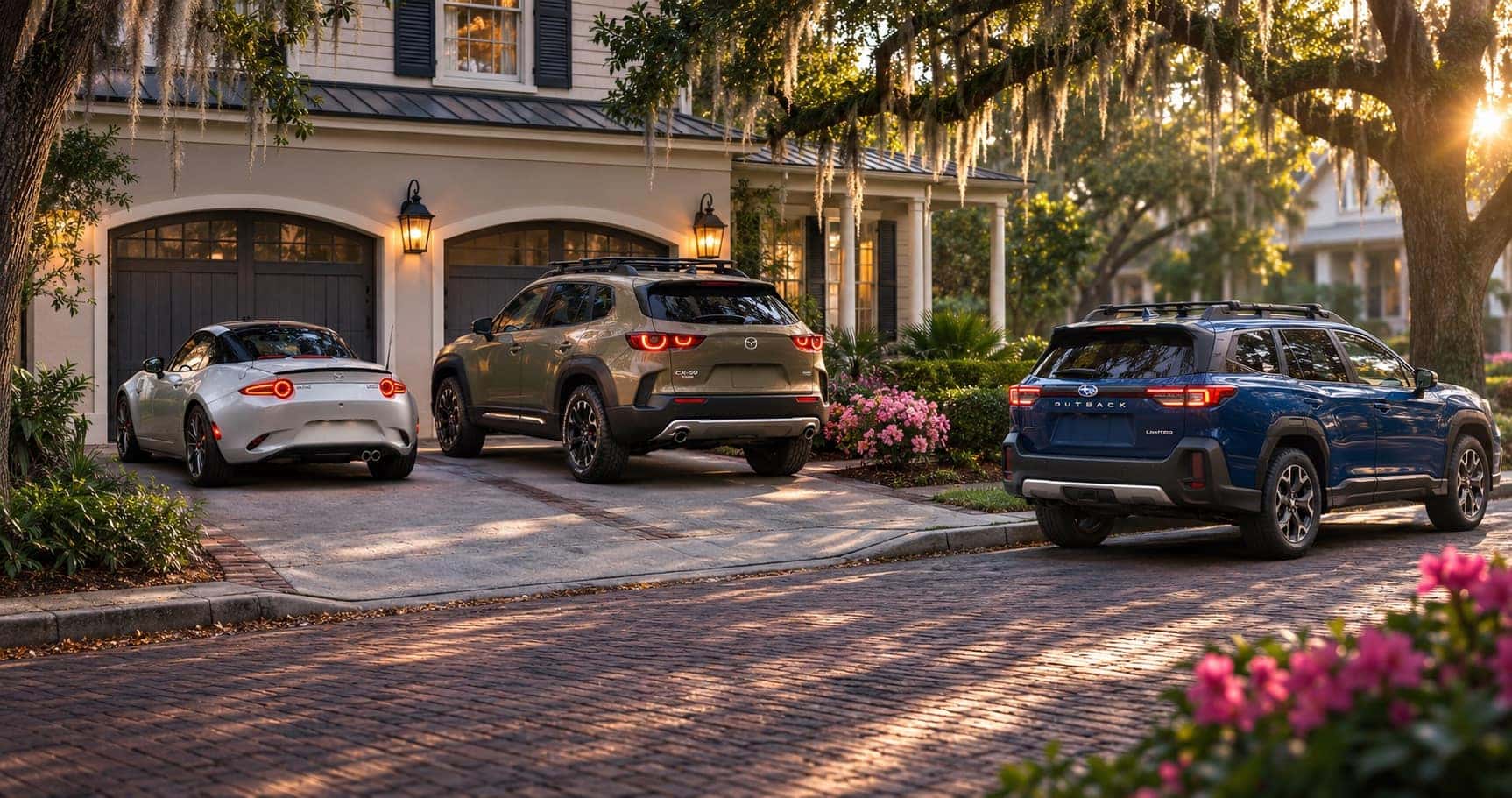
2026 Mazda MX-5 Miata Club and Mazda CX-50 parked in a Savannah, GA driveway with a 2027 Subaru Outback Limited parked along the curb at sunrise

Where the Brand Tradeoff Becomes Clear

Which Advantages Will You Actually Appreciate Every Day?

Mazda makes a compelling case through responsive road manners, thoughtful cabin design, and plug-in hybrid choices. Subaru emphasizes practical utility, specialized Wilderness models, and fully electric SUVs. Start with your non-negotiable requirements, then consider which advantages you would appreciate most in everyday driving.

Mazda

Make the Drive
Part of the Reward

Start with Mazda when its vehicles meet your seating and cargo needs and you want more enjoyment from the miles you drive most often. CX-30, CX-5, and CX-50 give shoppers different ways to balance everyday usefulness with a driver-focused approach. For households seeking rechargeable hybrid power with gasoline flexibility, the three-row 2027 CX-90 PHEV gives Mazda another meaningful distinction.

Where Mazda Makes Its Strongest Case

For daily trips around Savannah, commuting toward Pooler, or longer drives along the coast, steering response, seating comfort, control placement, and cabin materials are details you experience repeatedly. If Mazda's approach makes those miles more satisfying without compromising the room or capability you need, that is a valuable reason to choose it. Compare the exact models and equipment before deciding.

Subaru

Choose the Equipment
Your Plans Demand

Start with Subaru when frequent rough-road travel, a particular Wilderness configuration, or a fully electric SUV is central to your plans. Crosstrek, Forester, and Outback Wilderness offer model-specific trail-oriented equipment, while Solterra, Trailseeker, and Uncharted provide battery-electric choices that Mazda's current U.S. lineup does not match directly.

Where Subaru Earns Its Place

If your weekends regularly involve uneven access roads, the added tires, clearance, and equipment of a suitable Wilderness model may justify prioritizing Subaru. Its EV lineup also deserves the first look when driving without a gasoline engine is non-negotiable. For everyday SUV shopping, Forester's outward visibility and practical passenger access give shoppers additional reasons to compare it directly with Mazda.

When Both Brands Meet Your Needs

Let the Closest SUV Matchups Settle the Choice

Once both brands meet your essential requirements, compare the vehicles themselves. CX-30 and Crosstrek, CX-5 and Forester, CX-50 and Outback, or CX-90 and Ascent are useful starting points, though their sizes and configurations differ. On a familiar route, check seating comfort, passenger access, cargo space, visibility, controls, and driving response.

Then compare similarly equipped vehicles and actual purchase quotes. A small feature or price difference should not outweigh the experience you'll live with. Mazda makes its strongest case when its cabin and engaging road manners improve your everyday drive; Subaru deserves the nod when its particular space, visibility, or outdoor equipment better serves your needs.

Still weighing two strong choices?
Take the quiz to choose your first test drive.

3-Question Brand Fit Check

Which Brand Deserves Your First Drive?

Answer three questions about road use, charging, and the cabin you want to live with. A firm full-EV or plug-in-hybrid requirement takes priority over softer preferences.

Use These Three Questions as a Decision Checklist:

  1. Do you value paved-road response, rough-road equipment, or a balance of both?
  2. Do you require a plug-in hybrid, a full EV, or a vehicle without external charging?
  3. Would cabin layout, visibility and access, or an in-person comparison settle the choice?

Use these questions to choose a first drive, then compare the exact vehicles that meet your requirements.

Question 10 answered

Decision Question


Mazda vs Subaru FAQs

Is Subaru the Only Choice If I Want Standard AWD?

No. AWD is standard across Mazda's current U.S. SUVs, including electronic e-AWD on the CX-50 Hybrid. Subaru also makes Symmetrical AWD standard on its gas and conventional-hybrid SUVs, but the Uncharted Premium FWD electric SUV is an exception. Compare the exact model and powertrain rather than assuming every vehicle in either brand uses the same AWD system.

Which Mazda Is Closest to a Subaru Forester or Outback?

Start with the Mazda CX-5 versus the Subaru Forester for everyday compact-SUV use. The Mazda CX-50 also overlaps with the Forester or Outback depending on cargo needs and outdoor priorities. For a larger two-row Mazda, compare the outgoing 2026 CX-70 with the new two-row 2027 CX-90 inline-six configurations. Check usable cargo room with the seats arranged as you normally travel.

Are the Current Subaru Hybrids Plug-In Hybrids?

No. The Subaru Forester Hybrid and Crosstrek Hybrid are conventional, no-plug hybrids, as is the Mazda CX-50 Hybrid. Mazda also offers rechargeable plug-in hybrids: the outgoing 2026 CX-70 PHEV with two rows and the 2027 CX-90 PHEV with three rows. These PHEVs retain a gasoline engine and can be charged externally.

Which Brand Offers a Three-Row Plug-In Hybrid?

Mazda offers the 2027 CX-90 PHEV with three-row seating. Subaru's 2027 Ascent is a three-row gasoline SUV and has no plug-in-hybrid counterpart. If a third row and the ability to recharge a hybrid are both essential, start with the CX-90 PHEV. The new two-row 2027 CX-90 configurations are inline-six models, not PHEVs.

What Should I Compare Beyond AWD for Outdoor Trips?

Compare tires, ground clearance, drive modes, and trail-oriented equipment before choosing. Also check the exact vehicle's roof-load, towing, and payload ratings*; those limits vary by configuration and equipment. Subaru Wilderness models and Mazda CX-50 Meridian editions take different approaches to outdoor use. AWD does not make flooded roads safe to cross.

Do Mazda & Subaru Have the Same Basic Warranty Lengths?

Yes. Both publish 3-year/36,000-mile new-vehicle limited warranties and 5-year/60,000-mile limited powertrain warranties*. Coverage ends when the applicable time or mileage limit is reached first. Covered components, exclusions, electrified-vehicle coverage, and maintenance obligations must be checked in the warranty booklet for the exact model.

Shopping & Ownership Support

A Local Relationship That Supports
the Purchase & the Years After It

At J.C. Lewis Mazda, the experience extends beyond choosing a vehicle. From straightforward purchase numbers to convenient delivery arrangements and Mazda-specific service, our team helps make every stage of ownership easier.

Savannah Roots Dating Back to 1912

Our dealership is part of the J.C. Lewis automotive family, whose Savannah history began in 1912. That long-standing local connection brings a personal, relationship-focused approach to helping Coastal Georgia and Lowcountry drivers.

Clear Out-the-Door Pricing

Know what your purchase involves before you commit. Our team provides transparent, itemized out-the-door quotes so you can evaluate vehicle pricing, trade-in value, taxes, and applicable fees together rather than piecing together the final number.

Home Delivery Across the Southeast

Shopping from Richmond Hill, Bluffton, Hilton Head, or farther away? Ask our team about available home-delivery arrangements throughout the Southeast. We can help coordinate purchase details remotely and discuss delivery options before you make the trip to Savannah.

Mazda-Specific Support After the Sale

Our Mazda-trained service specialists, Mazda-backed technical resources, and Genuine Mazda Parts help support your vehicle well beyond the first drive. Online scheduling and Saturday service hours make it easier to fit maintenance into your routine.

Visit Our Savannah Dealership

J.C. Lewis Mazda

10101 Abercorn St
Savannah, GA 31406

Connect with our team to plan your visit, discuss your purchase, or get started from home.

TAKE YOUR NEXT STEP
Browse Inventory or Continue Learning


Disclaimers:
Model Years & Availability: U.S.-market information verified November 6, 2026. Model years, trims, powertrains, equipment, pricing, and local stock may change. The 2026 CX-70 is outgoing; selected 2027 inline-six CX-90 trims replace it with two-row configurations in the U.S. The 2027 CX-90 PHEV retains three rows.
MSRP & Pricing: The stated 2026 CX-50 Hybrid Preferred AWD ($34,750) and 2026 Forester Premium Hybrid AWD ($34,730) MSRPs exclude destination/delivery, taxes, title, registration, options, and applicable fees. Mazda destination is $1,595 ($1,640 in Alaska); Subaru destination is additional. Actual dealer pricing and installed equipment vary; request itemized out-the-door totals.
EPA Fuel Economy: EPA estimates for the named 2026 AWD vehicles are 39 city/37 highway MPG (CX-50 Hybrid) and 35 city/34 highway MPG (Forester Hybrid). Actual results vary by conditions, driving habits, maintenance, and vehicle condition. These are not brand averages.
AWD, Towing & Outdoor Equipment: AWD and drive modes cannot prevent all loss of control or make floodwater safe to cross. Tires, ground clearance, towing capacity, payload, roof load, and accessory limits depend on exact configuration; follow vehicle ratings, labels, and the owner's manual. Passengers, cargo, and trailer tongue weight affect available capacity.
Safety & Driver Assistance: IIHS 2026 TOP SAFETY PICK+ recognition for the Mazda CX-50 and Subaru Forester applies to those model years and published criteria, not either brand generally. Ratings and driver-assistance features do not guarantee crash prevention or substitute for an attentive driver. Features and operating limits depend on configuration.
Limited Warranties: Both brands publish 3-year/36,000-mile new-vehicle limited coverage and 5-year/60,000-mile limited powertrain coverage, whichever comes first. Components, exclusions, electrified-system coverage, emissions rules, and maintenance requirements vary; consult each model's warranty booklet.
Charging & Technology: PHEV gasoline-engine operation depends on charge and conditions; full EVs require external charging. Equipment, charging access, services, connectivity, subscriptions, and compatible devices vary by model and location.
Independent Reviews: Car and Driver ratings cited are for its 2027 gasoline CX-50 and Forester reviews, not hybrid reviews, brand averages, reliability ratings, or ownership guarantees. A 2027 review may include prior-model-year instrumented testing where indicated by the publisher.


Saved Vehicles

You don't have any saved vehicles!

Look for this Save icon

Once you've saved some vehicles, you can view them here at any time.

Get Directions

10101 Abercorn St, Savannah, GA, 31406
J.C. Lewis Mazda 31.991009716730076, -81.13119930230253.
tag ->