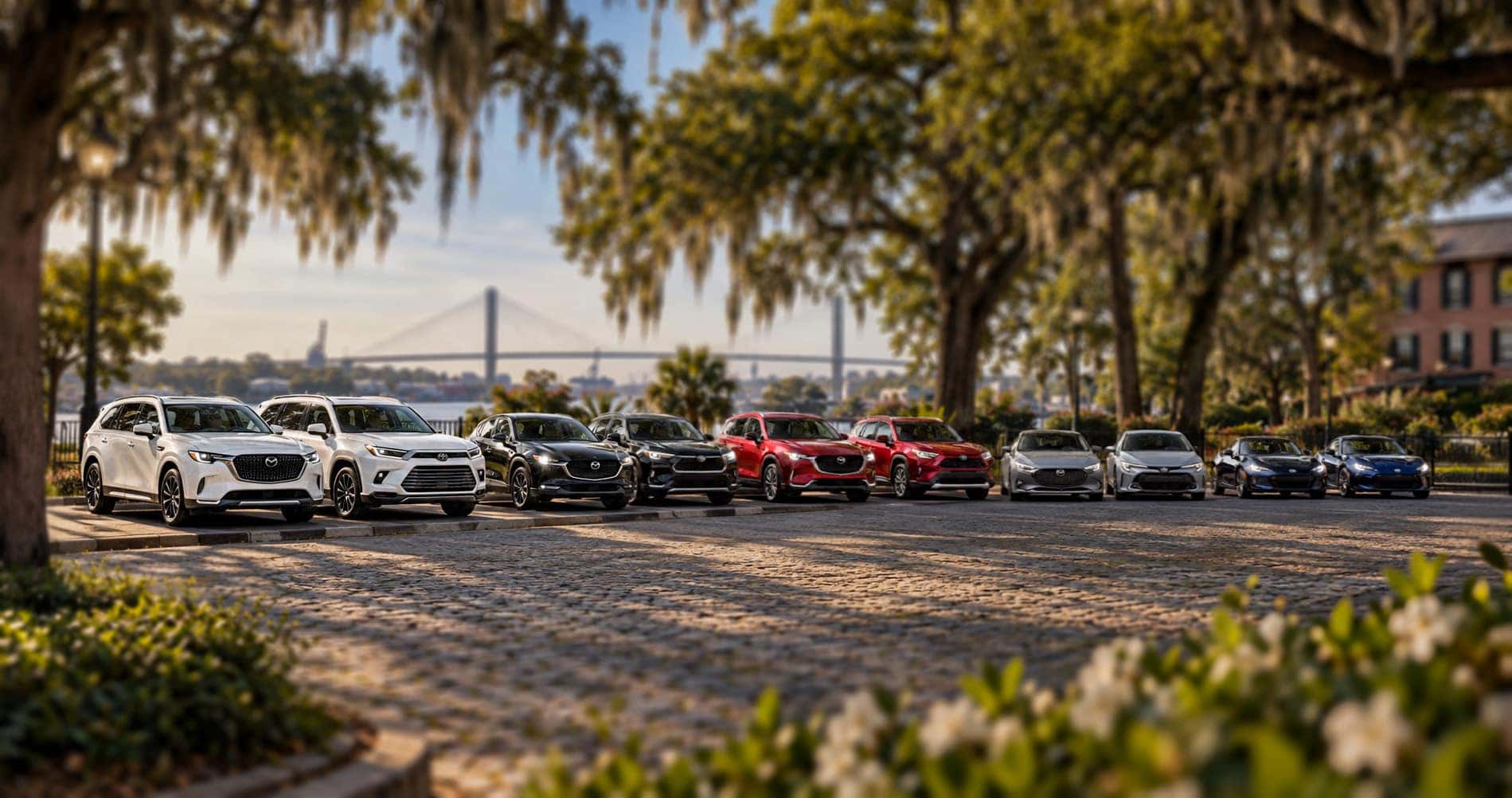
Mazda concentrates on cars and crossovers with a consistent driver-centered character. Toyota covers far more vehicle types and electrified paths. The useful question is which brand strategy better matches what you actually need.
Mazda and Toyota belong on the same Savannah-area shortlist because both give mainstream shoppers well-established Japanese brands, strong small-car and crossover choices, modern driver-assistance technology, and multiple ways to reduce fuel use. They overlap most naturally around vehicles such as Mazda3 and Corolla, CX-30 and Corolla Cross, CX-5 or CX-50 and RAV4, and CX-90 and Toyota's larger family SUVs. That overlap is real, but it does not make the brands interchangeable.
Mazda's U.S. lineup is comparatively concentrated around Mazda3, MX-5 Miata, and the CX crossover family. That gives the brand room to repeat a human-centered, driver-connection philosophy across a smaller portfolio. Toyota takes the opposite route: compact cars, family SUVs, hybrids, plug-in hybrids, EVs, a minivan, pickups, body-on-frame off-road vehicles, and GR performance models all live under the same badge. Toyota's breadth is a genuine advantage when you need one of those extra branches; Mazda's focus can be an advantage when its existing vehicle types already cover the job.
Around Savannah, the distinction can show up in ordinary routines rather than extreme use cases. A driver moving between city streets, I-16, I-95, Pooler, Richmond Hill, and Lowcountry weekend trips may care more about cabin usability, road manners, fuel strategy, and ownership support than about the largest possible lineup. This guide compares the brands first, then uses individual vehicles only where they clarify a real difference.
Buyer-Fit Shortcuts
Start With the Brand Priority That Repeats Most Often
Choose the priority that most closely matches what you want from the brand itself. Each result is a directional starting point; the comparison below shows where the other brand can still make a stronger case.
Based on This Priority
You Want the Drive and Cabin to Feel Deliberately Connected
Start With Mazda — CX-50 First
Why It Fits
Mazda makes human-centered design and driver connection part of the brand philosophy rather than reserving that idea for one performance model. CX-50 adds a more adventure-leaning crossover expression without leaving that road-focused foundation.
Also Compare
Toyota can still deliver comfortable, engaging vehicles, and its GR models go much further toward dedicated performance. The difference is that Toyota spreads its identity across many more comfort, efficiency, truck, off-road, and performance roles.
You Want a Small Crossover Without Giving Up a Polished Cabin
Start With Mazda — CX-30 First
Why It Fits
CX-30 is the compact entry point in Mazda's crossover ladder and suits shoppers who want a smaller footprint for daily Savannah driving while staying inside Mazda's design and driving philosophy.
Also Compare
Toyota Corolla Cross belongs on the same shopping list, especially when Toyota's hybrid availability or broader long-term lineup matters more than Mazda's tighter brand character.
You Want Electrification to Span More Vehicle Types
Start With Toyota
Why It Fits
Toyota currently distributes conventional hybrids, plug-in hybrids, and battery-electric choices across many more cars, crossovers, SUVs, and specialty vehicles. That makes powertrain type a brand-level choice rather than a smaller branch of the lineup.
Also Compare
Mazda's current electrified lineup is narrower but still covers meaningful roles: CX-50 Hybrid for no-plug efficiency and CX-70/CX-90 PHEV for plug-in flexibility, including a three-row PHEV path Toyota does not mirror directly for 2026.
Based on This Priority
Your Next Vehicle Needs a Role Mazda Does Not Currently Serve
Start With Toyota
Why It Fits
Tacoma, Tundra, Sienna, Land Cruiser, 4Runner, and Sequoia give Toyota truck, minivan, and dedicated off-road/family-utility roles that Mazda does not currently duplicate.
Also Compare
If your real need is a road-focused crossover rather than a pickup, minivan, or body-on-frame SUV, Mazda moves back into the conversation quickly because CX-30 through CX-90 cover a wide span of everyday passenger-vehicle roles.
Based on This Priority
You Specifically Want Three Rows and Plug-In Hybrid Flexibility
Start With Mazda — CX-90 PHEV First
Why It Fits
Mazda CX-90 PHEV combines three-row seating with a plug-in hybrid powertrain in the current U.S. lineup, giving Mazda a distinctive family-size electrified configuration.
Also Compare
Toyota offers a much broader set of hybrid family vehicles, including Grand Highlander Hybrid and Sienna. If plugging in is not required, Toyota's three-row and minivan choices become a larger field to compare.
You Want a Two-Seat Convertible to Be the Point, Not a Side Effect
Start With Mazda — MX-5 Miata First
Why It Fits
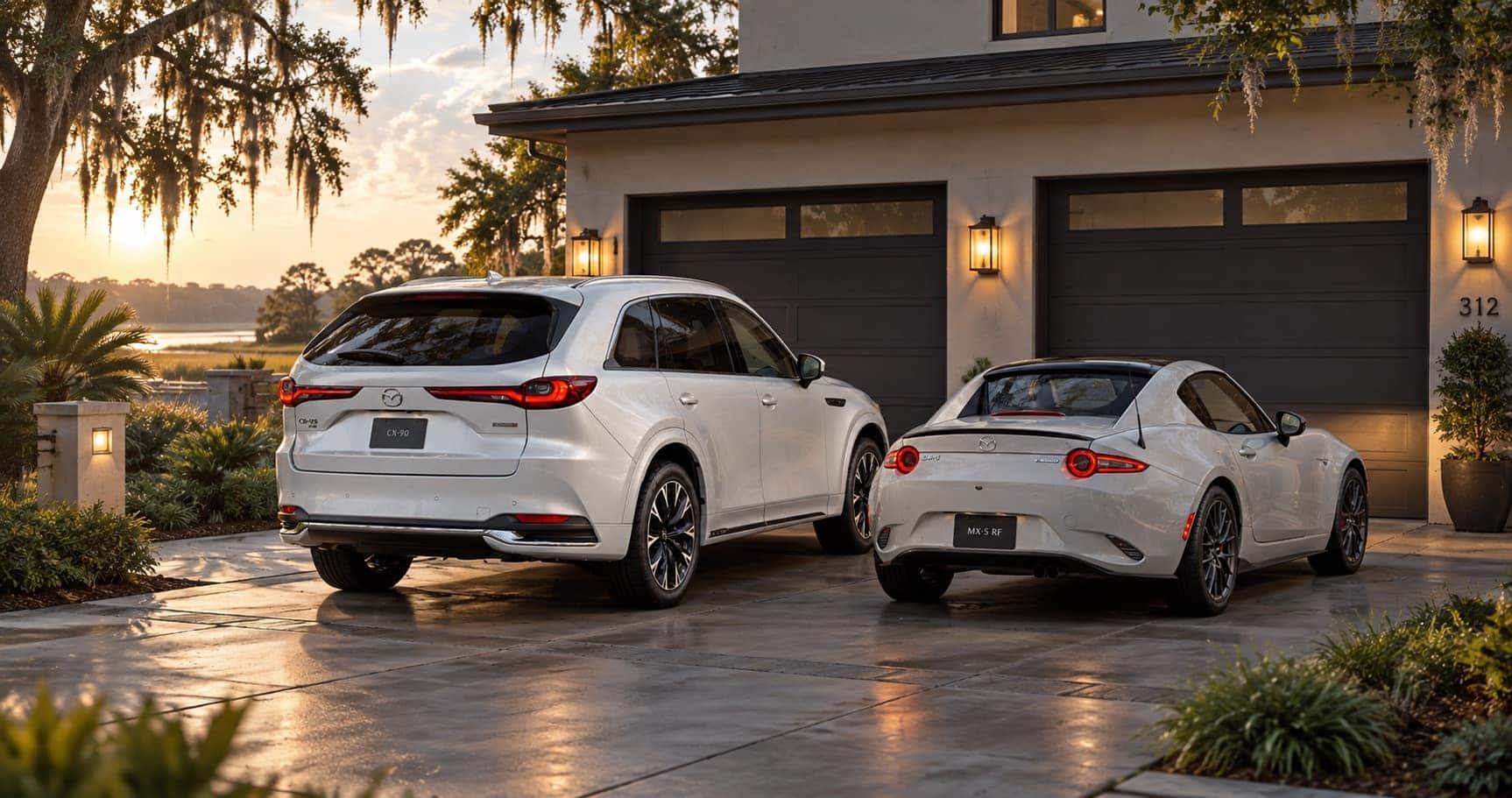
MX-5 Miata keeps a lightweight, rear-drive, two-seat roadster in Mazda's core lineup, including a soft top and retractable-fastback RF. Toyota has strong GR performance cars, but not a direct current open-top counterpart.
Also Compare
Toyota GR86, GR Corolla, and GR Supra make Toyota a serious enthusiast brand too. If fixed-roof performance, power, or all-weather GR capability matters more than the roadster format, Toyota deserves equal attention.
Mazda vs Toyota in 60 SecondsSix answers that clarify the brand-level decision▼
Which brand has the broader current U.S. lineup? Toyota. Its 2026 portfolio stretches across cars, crossovers, SUVs, a minivan, pickups, body-on-frame off-road vehicles, GR performance models, hybrids, plug-in hybrids, battery-electric vehicles, and the Mirai fuel-cell sedan. Mazda stays focused on Mazda3, MX-5 Miata, and the CX crossover/SUV family.
Which brand offers more hybrid, plug-in-hybrid, and EV choices right now? Toyota. Mazda currently offers CX-50 Hybrid plus CX-70 PHEV and CX-90 PHEV; Toyota spreads electrified powertrains across far more vehicle families and also offers dedicated battery-electric choices.
Which brand has broader 2026 IIHS award coverage among the models currently listed? Mazda. IIHS currently lists 2026 TOP SAFETY PICK+ awards for Mazda3 sedan and hatchback plus CX-30, CX-5, CX-50, CX-70/PHEV, and CX-90/PHEV. Toyota currently has 2026 TOP SAFETY PICK+ awards for Prius and Camry and a TOP SAFETY PICK for Tundra crew cab. These are model-specific awards, not a universal brand crash score.
Do Mazda and Toyota publish the same basic and powertrain warranty lengths? Yes. Both publish 3-year/36,000-mile basic or new-vehicle coverage and 5-year/60,000-mile powertrain coverage on current U.S. vehicles, subject to each manufacturer's terms and exclusions.
How do Mazda and Toyota compare in Consumer Reports road tests? Consumer Reports currently gives Mazda an average road-test score of 81 across its tested current models, ranking #12 among brands, versus Toyota at 77 and #21. The publication says each vehicle's road-test score summarizes more than 50 tests and evaluations, so the brand comparison reflects overall driving and user experience rather than one handling metric.
Which Mazda and Toyota models cross-shop most naturally? Mazda3 overlaps Corolla; CX-30 overlaps Corolla Cross; CX-5 and CX-50 both enter the RAV4 conversation from different angles; CX-90 can overlap Grand Highlander depending on seating and powertrain priorities; and MX-5 Miata can enter the same enthusiast shortlist as GR86 even though the roadster and coupe formats are different.
Where Do Mazda & Toyota Build Different Kinds of Ownership Experience?
Start with the brand-level split, then move through the areas that make it meaningful in a real purchase: lineup shape, driving and cabin philosophy, electrification, safety and technology, and the ownership support that remains after the test drive. Individual models appear as evidence for those patterns rather than as stand-ins for either brand as a whole.
Start With the Big Brand Difference; Then Compare by Priority
Start Here
Mazda Is More Focused; Toyota Gives Mainstream Shoppers More Branches
The central difference is not one feature. Mazda builds a smaller U.S. portfolio around Mazda3, MX-5 Miata, and a crossover ladder from CX-30 through CX-90. Toyota stretches across nearly every mainstream vehicle role. Breadth is a real Toyota advantage; Mazda's counterpoint is consistency when its existing lineup already contains the vehicle you need.
Pickups, minivan, body-on-frame SUVs & GR more ways to specialize without changing brands
2026 IIHS Snapshot*
Broad TOP SAFETY PICK+ coverage Mazda3 and multiple CX families currently listed
Prius & Camry TSP+; Tundra TSP current award list is narrower
Headline Warranty
3 yr / 36,000 mi new vehicle 5 yr / 60,000 mi powertrain
3 yr / 36,000 mi basic 5 yr / 60,000 mi powertrain
Current U.S.-market lineup and program details checked September 22, 2026. IIHS awards are model-specific and reflect tested vehicles and current award criteria; they are not a synthetic brand crash score.
Toyota's Breadth Matters Most When You Need One of the Extra Branches
A shopper who needs a Tacoma, Sienna, Land Cruiser, dedicated EV, or one of Toyota's many hybrid variations can eliminate Mazda on vehicle role alone. If your actual need already falls inside Mazda3, MX-5, or the CX crossover family, that advantage shrinks and the comparison moves toward cabin feel, road manners, safety evidence, electrification fit, and ownership support.
Lineup & Model Roles
Several Natural Cross-Shops Exist, but the Map Is Not One-to-One
Toyota's portfolio is large enough that one Mazda can overlap several Toyota models depending on powertrain, size, or capability. The useful comparison is the vehicle role, not forcing exact equivalents where the missions diverge.
Swipe to compare →
Natural Mazda and Toyota cross-shopping anchors
Vehicle Role
Mazda
Toyota
Compact Car
Mazda3 Sedan / Hatchback
Corolla / Corolla Hatchback Corolla also adds a dedicated hybrid sedan path.
Small Crossover
CX-30
Corolla Cross / Corolla Cross Hybrid
Compact SUV
CX-5 / CX-50 / CX-50 Hybrid CX-5 leans everyday-road; CX-50 adds a more rugged visual/capability angle.
RAV4 Hybrid / RAV4 PHEV 2026 RAV4 is fully electrified.
Two-Row Midsize SUV
CX-70 / CX-70 PHEV
No single direct counterpart Crown Signia, 4Runner, Land Cruiser, or RAV4 PHEV may overlap depending on the job.
Three-Row Family Vehicle
CX-90 / CX-90 PHEV
Highlander / Grand Highlander / Sienna / Sequoia role changes by seating, efficiency, towing, and off-road needs.
GR86 / GR Corolla / GR Supra multiple fixed-roof performance routes
No Direct Mazda Equivalent
No current pickup, minivan, body-on-frame 4×4, or dedicated BEV
Tacoma, Tundra, Sienna, 4Runner, Land Cruiser, Sequoia, bZ family & more
The RAV4 Question Shows Why Brand Comparisons Need More Than One-to-One Pairings
A Savannah shopper looking at RAV4 may reasonably cross-shop CX-5, CX-50, or CX-50 Hybrid depending on whether the priority is polished everyday road manners, a more adventure-leaning crossover, or no-plug hybrid efficiency. Toyota's broader lineup makes it easier to stay in-brand as needs change; Mazda's smaller lineup can make the path clearer when the preferred role is already covered.
Driving & Cabin Philosophy
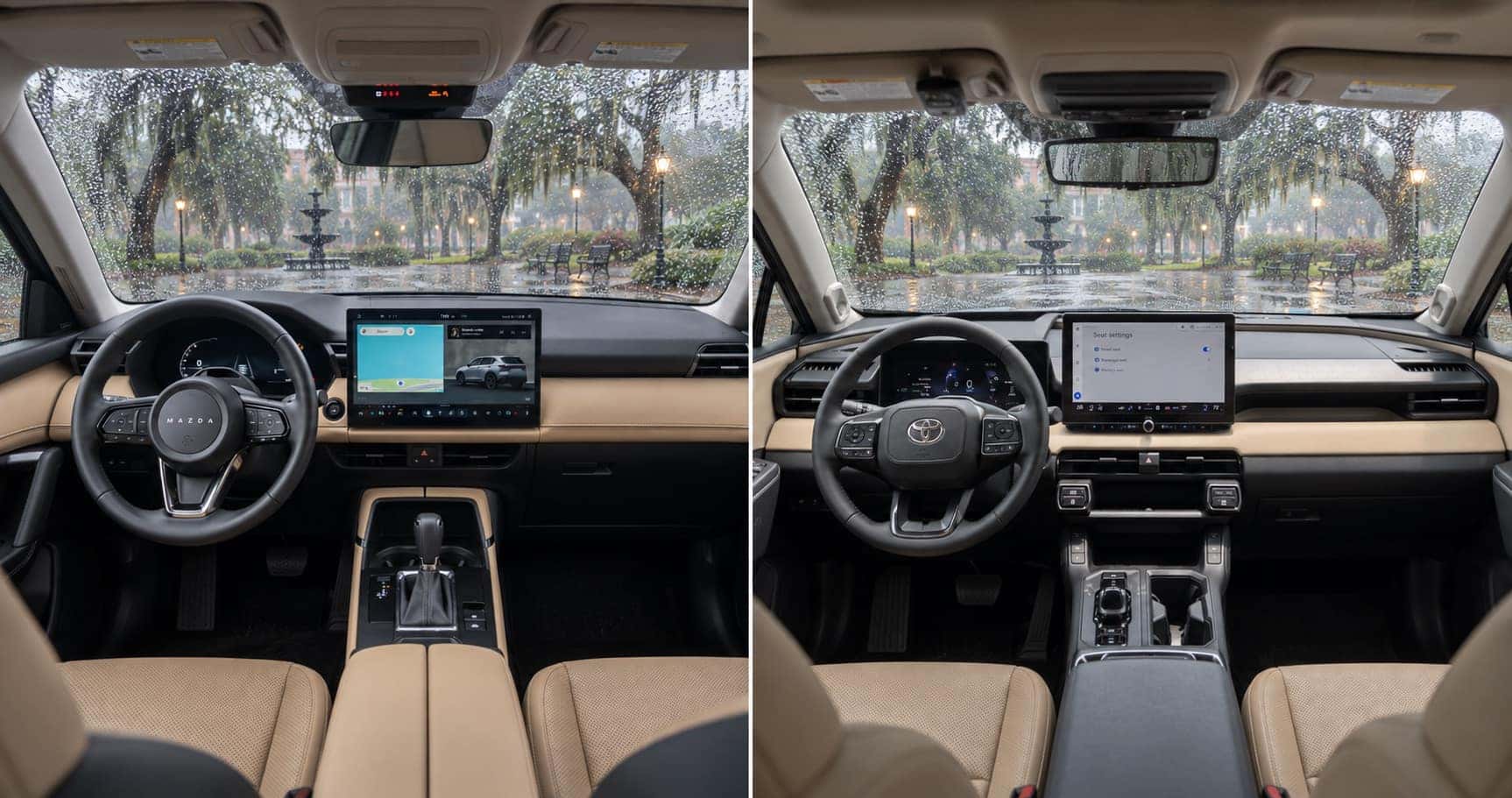
Mazda Tries to Repeat One Driving Philosophy; Toyota Builds Several Personalities
Mazda describes its development around human-centered engineering and Jinba Ittai — a sense of connection between car and driver. Toyota is harder to reduce to one driving identity because its portfolio includes comfort-oriented family models, efficiency-first hybrids, trucks and off-road SUVs, and dedicated GAZOO Racing performance vehicles.
Swipe to compare →
Driving, design and cabin priorities
Decision Point
Mazda
Toyota
Brand-Level Driving Idea
Human-centered connection driver position, control feel and vehicle response are treated as one system.
Purpose changes by vehicle family comfort, efficiency, utility, off-road capability and GR performance all coexist.
Cabin Direction
Clean, driver-oriented layouts across many models materials and control placement are used to reinforce a cohesive feel.
Varies more by segment and mission Prius, RAV4, Tacoma, Sienna and GR models are intentionally different products.
Performance Expression
Driving response remains visible in mainstream models MX-5 is the dedicated enthusiast anchor.
GR creates distinct performance branches GR86, GR Corolla, GR Supra and GR-developed variants go further toward track-inspired performance.
Utility / Trail Emphasis
CX-50 adds the clearest adventure-oriented Mazda angle still crossover-based.
Dedicated truck and off-road architecture exists Tacoma, 4Runner, Land Cruiser, Tundra and Sequoia cover heavier-duty roles.
For Savannah Pavement, Mazda's Consistency Is Easier to Feel Than to Summarize
On daily commutes, bridge approaches, I-16 runs, and longer Lowcountry drives, the useful question is whether you prefer Mazda's attempt to make steering, seating, controls, and cabin presentation feel related across models. Toyota can absolutely deliver good road manners, but the Toyota experience is intentionally less uniform because a Prius, RAV4, Tacoma, Sienna, Land Cruiser, and GR86 are solving very different jobs.
Powertrains & Electrification
Toyota Offers More Breadth; Mazda Has a Smaller Set of Clearly Defined Electrified Roles
Toyota's electrification strategy reaches across much more of the lineup. Mazda's current U.S. strategy is easier to summarize: a conventional hybrid compact SUV plus plug-in-hybrid two- and three-row SUVs, alongside gasoline Mazda3, MX-5, and crossover choices.
Swipe to compare →
Current U.S. powertrain and electrification paths
Powertrain Path
Mazda
Toyota
Gasoline
Still central to most of the lineup naturally aspirated and turbo choices, including inline-six CX-70/CX-90 variants.
Still available in multiple cars, trucks & SUVs often paired with hybrid alternatives elsewhere in the same portfolio.
Conventional Hybrid
CX-50 Hybrid one no-plug hybrid family for 2026.
Broad hybrid coverage Corolla, Camry, Prius, Corolla Cross, RAV4, Highlander, Grand Highlander, Sienna and select trucks/SUVs.
Plug-In Hybrid
CX-70 PHEV & CX-90 PHEV includes a three-row plug-in-hybrid route.
Prius PHEV & RAV4 PHEV broader electrified lineup overall; no direct 2026 three-row PHEV counterpart to CX-90 PHEV.
Battery Electric / Fuel Cell
No 2026 Mazda BEV listed in the current U.S. retail lineup
bZ-family BEVs + Mirai fuel cell Toyota keeps additional zero-tailpipe-emission routes in the current portfolio.
Performance Powertrains
MX-5 roadster + turbo Mazda3/CX variants
Dedicated GR86, GR Corolla & GR Supra families GR development makes performance a more distinct sub-brand.
The Electrification Decision Is About Shape, Not Just Quantity
Toyota is the obvious starting point when the shopper wants electrification available across the widest range of vehicle types. Mazda becomes more competitive when the need is already specific: a compact no-plug hybrid SUV, a two-row PHEV, or a three-row PHEV. For Savannah-area shoppers who can charge at home, CX-70 PHEV and CX-90 PHEV create a clear Mazda path without asking the brand to match Toyota model-for-model.
Safety, Technology & Driver Assistance
Both Brands Invest Heavily in Driver Assistance; Current IIHS Award Breadth Favors Mazda
Mazda groups its advanced safety and driver-support features under i-ACTIVSENSE. Toyota uses Toyota Safety Sense, with the generation varying by model — including TSS 3.0 across many vehicles and TSS 4.0 on the redesigned 2026 RAV4. The crash-test picture should be read model by model rather than turned into one invented brand score.
Swipe to compare →
Safety, interface and connected-technology direction
Decision Point
Mazda
Toyota
Driver-Assistance Family
i-ACTIVSENSE active-safety and pre-crash technologies; exact systems vary by vehicle and trim.
Toyota Safety Sense TSS generation and feature set vary by model; 2026 RAV4 introduces TSS 4.0.
2026 IIHS Awards*
TSP+ currently listed across Mazda3 and major CX families Mazda3 sedan/hatch, CX-30, CX-5, CX-50, CX-70/PHEV, CX-90/PHEV.
TSP+ Prius & Camry; TSP Tundra crew cab current 2026 award list is narrower.
Infotainment Direction
Mazda Connect / model-specific displays commander/touchscreen use varies by model; layouts emphasize driver reach and lower-distraction control.
Toyota Audio Multimedia / model-specific generations 2026 RAV4 launches Toyota's newer system with 5G connectivity and updated voice functions.
Connected Features
MyMazda and model-dependent connected services cameras, parking aids and driver-support upgrades vary by configuration.
Toyota app, connected services & model-dependent advanced aids some functions require trials or subscriptions.
IIHS awards are vehicle-specific and depend on model year, tested configuration, size class, and award criteria. Driver-assistance technology does not replace an attentive driver; feature availability varies by vehicle and trim.
Mazda's Current Safety Evidence Is a Brand Strength, but the Exact Vehicle Still Matters
Mazda's broad 2026 TOP SAFETY PICK+ presence is meaningful because it spans several of the vehicles Savannah-area shoppers are most likely to compare. It should not be stretched into a claim that every Mazda is automatically safer than every Toyota. Toyota's Prius and Camry also hold 2026 TOP SAFETY PICK+ awards, and the right comparison remains the exact tested model and configuration.
Value, Warranty & Ownership
The Headline Warranty Is Similar; Roadside and Battery Coverage Create the Clearer Differences
Mazda and Toyota publish the same basic/new-vehicle and powertrain warranty lengths, so those headline numbers do not settle the choice. The clearer differences are how roadside assistance is structured and how long high-voltage battery coverage extends on electrified models.
Swipe to compare →
Warranty and ownership coverage context
Ownership Item
Mazda
Toyota
Basic / New-Vehicle Warranty*
3 yr / 36,000 mi
3 yr / 36,000 mi
Powertrain Warranty*
5 yr / 60,000 mi
5 yr / 60,000 mi
Roadside Assistance*
3 yr / 36,000 mi Mazda 24/7 program tied to new-vehicle coverage.
2 years / unlimited miles standard new-vehicle roadside assistance; some electrified models and Mirai use different terms.
High-Voltage Battery*
8 yr / 100,000 mi 2026 hybrid/PHEV high-voltage battery coverage; some emissions states may have longer coverage.
10 yr / 150,000 mi hybrid battery model year 2020+ Toyota hybrids, subject to warranty terms.
Warranty and program terms vary by vehicle, model year, market, exclusions, and eligibility.
The Clearest Ownership Difference Is Electrified Coverage
The basic and powertrain warranties are essentially a wash. Mazda gives one additional year of roadside-assistance time but caps mileage at 36,000, while Toyota's standard roadside period is shorter at two years with unlimited miles. For hybrid shoppers, Toyota's published 10-year/150,000-mile hybrid-battery coverage extends beyond Mazda's standard 8-year/100,000-mile high-voltage-battery coverage. Those differences matter most when they match the powertrain and mileage pattern of the exact vehicle being considered.
Independent Road-Test Perspective
Consumer Reports Gives Mazda the Higher Current Brand Road-Test Average
Consumer Reports | Brand Road-Test Ranking
Mazda
81 / 100 Average Road-Test Score
Road-Test Rank: #12 among brands Brand Average: 81 / 100
That result fits Mazda's long-running emphasis on making the drive itself part of the product. Consumer Reports' individual testing shows the theme in different forms: it praises the CX-50 for responsive, well-weighted steering and sporty on-road handling, while describing the CX-70 as one of the finest-handling two-row SUVs. Not every Mazda is tuned the same way, but steering, handling, control feel, and cabin execution remain visible priorities across the tested lineup.
Road-Test Rank: #21 among brands Brand Average: 77 / 100
Toyota's 77 average still reflects capable all-around vehicles, but its driving character varies more by mission. Consumer Reports describes the 2026 Camry as balancing ride comfort with capable handling and the redesigned RAV4 as comfortable and predictable rather than enthusiast-focused. That fits Toyota's broader portfolio: efficiency, comfort, utility, off-road ability, and GR performance are tuned for different jobs instead of one uniform brand-wide feel.
Mazda's Its value is that it independently supports a pattern already visible in Mazda's engineering philosophy: steering response, handling, and a cohesive driver environment remain priorities across a broad share of its tested lineup. Toyota remains competitive through comfort, efficiency, and vehicle-specific tuning, but its driving experience depends more heavily on the exact model and mission.
Consumer Reports' brand road-test ranking averages the scores of current models it has tested from each automaker. Individual vehicle road-test scores combine more than 50 tests and evaluations. Brand averages are directional context, not a guarantee for any individual model.
Ready to Put Mazda's Side in Context?
Put the Brand Philosophy Into a Real Drive
Use an in-person visit to compare seating, visibility, controls, cargo access, and the road response of the Mazda model that actually fits your routine.
Mazda Makes the Stronger Case When You Prefer Focus & Diligence Over a Broader Lineup
Mazda is easiest to understand when the vehicle you need already exists inside its lineup. If you are shopping a compact car, small crossover, compact SUV, two-row or three-row crossover, or a lightweight roadster, Mazda can make a persuasive case through a consistent human-centered driving philosophy, cohesive cabin and design direction, current CX-50/CX-70/CX-90 electrified options, broad 2026 IIHS TOP SAFETY PICK+ coverage among its current model families, and a higher current Consumer Reports brand road-test average. Those strengths matter most when Mazda already covers the vehicle role you need.
Toyota is harder to beat when the requirement itself expands. A pickup, minivan, body-on-frame off-road SUV, dedicated battery-electric vehicle, or the widest possible hybrid selection gives Toyota a structural lineup advantage; its hybrid-battery coverage also extends beyond Mazda's standard high-voltage-battery warranty. For Savannah drivers, the practical boundary is whether you value Mazda's concentrated driving-and-design identity inside a vehicle type it already serves, or Toyota's ability to cover more missions and electrified paths under one badge. The three questions below reduce that choice to the priorities that repeat most often in your routine.
3-Question Brand Fit Check
Which Brand Direction Fits Your Routine Better?
Answer three questions about vehicle role, powertrain breadth, and the kind of driving experience you want to carry the most weight. The result gives you a starting point, not a universal winner.
Use these three questions as a decision checklist:
Does Mazda already sell the exact type of vehicle you need, or do you need one of Toyota's additional truck, minivan, off-road, or EV roles?
Is Mazda's current hybrid/PHEV range enough, or do you want Toyota's much broader electrified portfolio?
Do you want a more consistently driver-centered feel across everyday models, or are you comfortable with the driving character changing more by vehicle mission?
Even without JavaScript, those questions narrow the brand decision.
Treat the result as a starting direction, then verify the exact vehicle, powertrain, equipment, transaction terms, and in-person experience before deciding.
Mazda vs Toyota FAQs
Which brand scores better in Consumer Reports road tests?▼
Consumer Reports currently gives Mazda an average road-test score of 81 and ranks it #12 among brands, compared with Toyota at 77 and #21. The brand ranking averages the road-test scores of current models Consumer Reports has tested, so it is a directional view of overall driving and user experience rather than a guarantee that every Mazda will outscore every Toyota.
Which brand offers more hybrids and electric vehicles?▼
Toyota offers the broader current electrified portfolio, with hybrid, plug-in-hybrid, battery-electric, and fuel-cell options across more vehicle categories. Mazda's 2026 electrified choices are CX-50 Hybrid, CX-70 PHEV, and CX-90 PHEV.
Do Mazda and Toyota have the same new-vehicle warranty?▼
Their headline U.S. coverage is the same: both publish 3-year/36,000-mile basic or new-vehicle coverage and 5-year/60,000-mile powertrain coverage. Roadside assistance differs: Mazda publishes 3 years/36,000 miles, while Toyota's standard program is 2 years/unlimited miles; some electrified Toyotas and Mirai use different terms. Toyota also publishes 10-year/150,000-mile hybrid-battery coverage, while Mazda's current hybrid/PHEV high-voltage-battery coverage is generally 8 years/100,000 miles. Terms, exclusions, and emissions-state rules vary.
Which Mazda is closest to the Toyota RAV4?▼
Both Mazda CX-5 and CX-50 can cross-shop with RAV4, but for different reasons. CX-5 is the more road-focused everyday compact SUV; CX-50 adds a more rugged, adventure-leaning angle; and CX-50 Hybrid is the direct Mazda no-plug hybrid path. Compare the exact configurations rather than forcing one Mazda to be the universal RAV4 equivalent.
Does Mazda make a pickup truck or minivan like Toyota?▼
Not in the current U.S. Mazda lineup. Toyota sells Tacoma and Tundra pickups plus the Sienna minivan, along with several body-on-frame SUVs. If one of those vehicle roles is required, Toyota has a structural lineup advantage rather than merely a feature advantage.
Which brand has stronger current IIHS safety-award coverage?▼
Among the 2026 vehicles currently listed by IIHS, Mazda has broader TOP SAFETY PICK+ coverage across Mazda3 and several CX families. Toyota currently has TOP SAFETY PICK+ awards for Prius and Camry and a TOP SAFETY PICK for Tundra crew cab. IIHS awards are model-specific, so this should not be interpreted as a claim that every Mazda is safer than every Toyota.
Shopping & Ownership Support
Why Savannah-Area Shoppers Use J.C. Lewis Mazda Before & After the Sale
At J.C. Lewis Mazda in Savannah, the dealership's model research pages and Mazda Digital Showroom let shoppers do more than browse inventory before they arrive. The online showroom offers instant pricing and deal-building tools, so the in-store visit can stay focused on the parts a screen cannot settle: seating position, visibility, cargo access, control layout, ride quality, and road feel.
The online finance application and trade-value tools can move more of the transaction planning forward before the visit. For shoppers coming from Pooler, Richmond Hill, Brunswick, or the South Carolina Lowcountry, that can mean less store time spent starting paperwork and more time evaluating the Mazda that actually fits the trip.
After purchase, J.C. Lewis Mazda supports routine maintenance and repair with factory-trained Mazda technicians, Mazda diagnostic equipment, Genuine Mazda Parts, online scheduling, and Saturday service hours. That keeps service tied to Mazda-specific expertise while giving Savannah-area owners an additional appointment window when weekday schedules are full.
Disclaimers:
*Current Mazda and Toyota U.S.-market lineup information was checked September 22, 2026. Model years, trims, powertrains, availability, pricing, feature packaging, and announced product timing can change; the market is in a 2026/2027 model-year transition, so verify the exact vehicle before purchase.
*Brand-level model roles are directional. Mazda and Toyota do not offer one-to-one equivalents across their full portfolios, and several vehicles can overlap depending on size, powertrain, seating, capability, and budget. Compare the exact vehicles and configurations serving the same job.
*IIHS TOP SAFETY PICK and TOP SAFETY PICK+ awards are model-specific and depend on the tested model year, configuration, size class, and current award criteria. Award counts are not a synthetic brand-wide crash score. Driver-assistance systems have limitations and do not replace an attentive driver.
*Both brands publish 3-year/36,000-mile basic or new-vehicle coverage and 5-year/60,000-mile powertrain coverage on current U.S. vehicles. Mazda's standard 2026 high-voltage-battery warranty is generally 8 years/100,000 miles; Toyota publishes 10-year/150,000-mile hybrid-battery coverage for model year 2020 and newer hybrid vehicles. Roadside-assistance terms vary by vehicle; some electrified Toyota models and Mirai use different program terms. Warranty and program eligibility, exclusions, emissions-state rules, and terms can change.
*Consumer Reports' current brand road-test ranking averages the road-test scores of current models it has tested from each brand. Individual vehicle road-test scores are based on more than 50 tests and evaluations; brand averages do not guarantee how one specific Mazda and Toyota will compare. External links are provided only to the cited third-party road-test source.