

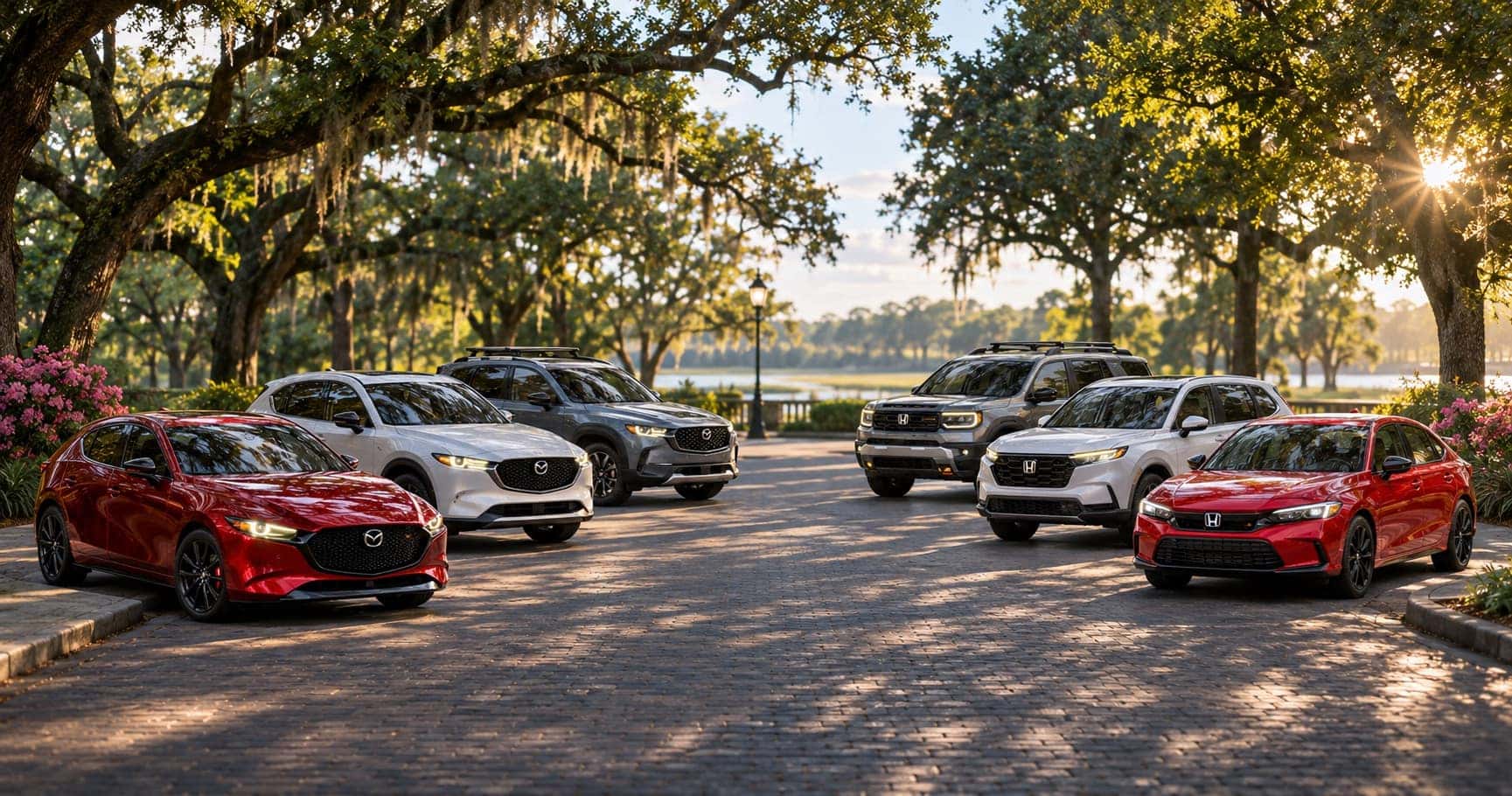
Mazda3 Hatchback, CX-5 and CX-50 facing Honda Civic Hatchback, CR-V and Passport on a cobblestone street beneath oak trees in Savannah, GA

SUV Comfort & Everyday Value in Coastal Georgia

Mazda vs Honda

Which Brand Gives You More of What You Value?

A cabin you enjoy, room for your everyday plans & equipment that feels worth the price.
Compare how Mazda & Honda bring those priorities together in their SUVs.


Mazda and Honda belong on the same shortlist because both offer SUVs suited to commuting, family errands and longer trips. Choosing between them takes more than comparing badges or feature lists. Seat comfort, passenger room, storage and the way a vehicle responds all contribute to how much you enjoy owning it—and which features feel worth paying for.

The lineups overlap in several useful places. CX-30 and HR-V serve smaller-crossover needs; CX-5 and CX-50 both enter the CR-V conversation; and CX-90 and Pilot address larger-family needs. Those pairings give you practical starting points, while differences in cabin design, seating arrangements and powertrain choices make the exact model worth a closer look.

Around Savannah, your week might include a Pooler commute on I-16, errands along Abercorn Street and a weekend drive south toward Brunswick or Jekyll Island. A comfortable driving position matters during the commute; passenger space and room for travel bags become more noticeable when everyone comes along. Start with what your household needs to carry, then weigh the comfort, driving experience and ownership costs that matter most to you.

Your Everyday Priorities

Which Part of SUV Ownership Matters Most to You?

Choose the priority that would make the biggest difference in your next vehicle. Each result suggests where to start, plus what to compare before making your choice.


Based on Your Priority

You Value the Cabin & the Drive

Start with Mazda — CX-50 First

Why It Fits

CX-50 gives you a driver-oriented cabin and an engaging road feel to evaluate together. Start here if you want the daily commute to feel more rewarding, then compare the seat materials, adjustments and comfort features on the trim you are considering.*

Also Compare

Keep CR-V in view if rear-seat comfort and luggage space carry equal weight. Bring your regular passengers and set the front seats to your usual positions before comparing how well each cabin works for everyone.

Based on Your Priority

You Want More Room for Your Regular Passengers

Start with Honda — CR-V or Pilot First

Why It Fits

CR-V is a useful starting point for compact-SUV passenger needs; Pilot adds three-row seating. On equipped 2026 Pilot trims, the stowable second-row center seat adds flexibility when your seating needs change.*

Also Compare

Compare CX-5 with CR-V and three-row CX-90 configurations with Pilot. Try your child seats, passenger arrangement and usual luggage in the appropriate pair before treating either brand as the better space choice.*

Based on Your Priority

You Want Hybrid Driving without Plugging In

Keep Both — Compare the Compact Hybrids

Why Both Fit

CX-50 Hybrid and CR-V Hybrid combine a gasoline engine with electric assistance and replenish their hybrid batteries while driving. Neither requires external charging, so you can keep your usual refueling routine.*

What to Compare

CX-50 Hybrid includes electronic AWD. CR-V Hybrid offers FWD or AWD, depending on trim. Compare equivalent drivetrains and equipment, then weigh passenger space, cargo fit and the complete purchase price.*

Based on Your Priority

You Want Plug-In Charging & a Third Row

Start with Mazda — CX-90 PHEV First

Why It Fits

CX-90 PHEV combines three-row seating, plug-in charging and a gasoline engine. It is a relevant starting point if you can charge regularly and want a family SUV that also accommodates longer gasoline-powered trips.*

Also Compare

Pilot provides three-row gasoline-SUV seating; Prologue is a two-row battery-electric SUV. Neither directly duplicates the CX-90 PHEV combination, so establish your seating and charging requirements before comparing equipment.*

Based on Your Priority

You Need Sliding Doors or a Pickup Bed

Start with Honda

Why It Fits

Odyssey’s sliding doors and Ridgeline’s open pickup bed address needs Mazda’s current U.S. cars and SUVs do not duplicate. Start here if minivan access or an open cargo bed is essential to how you use the vehicle.

Also Compare

If an enclosed SUV already handles your passengers and gear, Mazda remains a relevant choice. Compare the SUV that fits that job; the additional body styles matter most when you would actually use their different layouts.

Based on Your Priority

You Want Included AWD in a Smaller SUV

Start with Mazda — CX-30 First

Why It Fits

CX-30 includes AWD across its current lineup, giving you that equipment as you compare trims. Its smaller-crossover format is also worth checking if tight parking spaces and everyday errands influence your vehicle choice.*

Also Compare

HR-V also offers AWD. Compare an AWD-equipped HR-V with the CX-30, including the features and full purchase figures you want, then let cabin fit and driving preference help settle the choice.*

Mazda vs Honda in 60 SecondsSix Answers before You Choose a Model

Which SUVs Should I Compare First?
Start with CX-30 vs HR-V, CX-5 or CX-50 vs CR-V, and three-row CX-90 vs Pilot. For larger two-row SUVs, compare the 2026 CX-70 or a two-row 2027 CX-90 configuration with Passport.*


Which Brand Includes AWD?
Mazda includes AWD across its current U.S. SUV lineup; CX-50 Hybrid uses electronic AWD. Honda’s approach varies: HR-V and CR-V offer FWD or AWD, while Passport includes AWD.*


Do Both Brands Offer Hybrids without Plugging In?
Yes. Mazda offers CX-50 Hybrid; Honda offers hybrid versions of CR-V, Civic, Accord and Prelude. These conventional hybrids do not require external charging.*


Which Brand Offers a Three-Row Plug-In Hybrid?
Mazda, through CX-90 PHEV. Honda’s Pilot is a three-row gasoline SUV, while Prologue is a two-row battery-electric SUV. Neither directly duplicates that seating-and-powertrain combination.*


Do Both Brands Have Similar Warranty Coverage?
Yes. The gasoline and hybrid vehicles discussed share 3-year/36,000-mile new-vehicle limited coverage and 5-year/60,000-mile powertrain limited coverage, whichever comes first. Separate battery, emissions and EV terms apply.*


Do Starting Prices Include the Same Equipment?
Not necessarily. The 2026 CX-30 includes AWD, while the 2027 HR-V starts with FWD and offers AWD. Compare equivalent drivetrains and desired features, then review the full out-the-door quotes.*
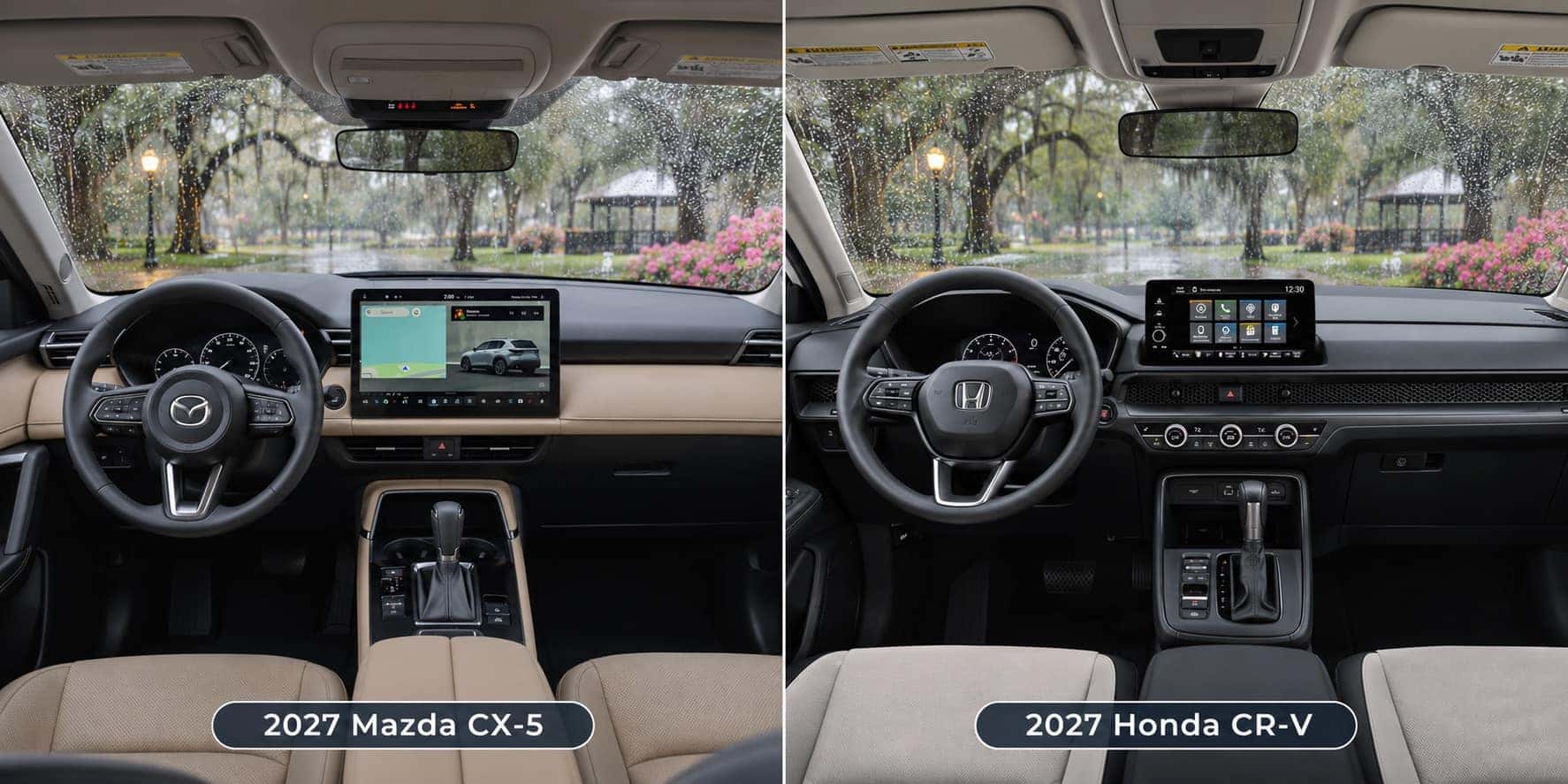
2027 Mazda CX-5 and 2027 Honda CR-V interiors shown side by side, comparing dashboard layouts and cabin materials on a rainy day in Savannah, GA

How Do Mazda & Honda Turn SUV Features into Everyday Value?

Compare the SUV roles, comfort, charging options, cabin technology and equipment behind the price. Each model example illustrates a particular choice; it does not speak for every vehicle in the brand.

Start With the Big Brand Difference; Then Compare by Priority


The Big-Picture Difference

Mazda Makes Driving Part of the Value; Honda Offers More Family Formats

Both brands can handle a commute, school pickup and a weekend away. The more revealing question is which parts of that routine you want the vehicle to make better.

How Each Brand Approaches the Same Everyday Priorities
Decision Point Mazda Honda
What the Design Emphasizes • Driver connection:
• Cabin layout, steering response and vehicle balance are recurring Mazda priorities. The CX-5 and CX-50 translate that focus into different SUV personalities.
• Everyday versatility:
• Passenger access, adaptable cabins and simple routines are prominent in CR-V, Pilot and Odyssey, alongside enjoyable road manners.
How You Shop for an SUV • Multiple interpretations of compact:
• CX-5 leans toward a refined roadgoing SUV; CX-50 adds a more outdoors-oriented alternative and an available hybrid.
• One broad compact family:
• CR-V covers gasoline, hybrid and TrailSport Hybrid needs within a single nameplate, with roomier alternatives above it.
The AWD Decision* • Built in:
• Standard AWD on the CX-30, redesigned CX-5, CX-50 and CX-90 means it is already part of the baseline equipment conversation.
• Choose your drivetrain:
• HR-V and CR-V offer FWD or AWD configurations; Passport includes AWD. That flexibility can matter to a shopper who does not require AWD.
A Different Electrification Mix* • Hybrid and plug-in options:
• CX-50 Hybrid does not need a charger; CX-90 PHEV can use external charging while retaining gasoline power.
• Hybrid across more body styles:
• CR-V, Civic, Accord and Prelude include hybrid choices; the outgoing 2026 Prologue represents a separate battery-electric path.
Beyond Conventional SUVs • For the driver:
• Mazda3 sedan/hatchback and MX-5 roadster offer compact-car and open-top choices beyond the crossover lineup.
• For a specific family task:
• Odyssey provides sliding doors, Ridgeline offers a pickup bed, and Civic/Accord expand the car choices.
*Model-year and trim availability vary. Standard versus available AWD is configuration-specific, and AWD does not overcome tire or traction limitations. Electrified vehicles use different systems; charging access and remaining 2026 Prologue inventory vary.

Start With the Experience, Then Narrow the Model

If you want your commute to feel more engaging, spend meaningful time in the Mazda driver’s seat. If sliding doors, a particular seating layout or a wider range of body styles is nonnegotiable, Honda may offer the more direct solution. Neither brand gets the win by default; the next test is how the specific SUV fits your people, gear and driving style.

SUVs & Model Roles

Cross-Shop by the Job the SUV Must Do

A similar footprint does not always mean a similar personality. These are the natural starting pairs—and the differences worth investigating before you choose a trim.

Where the Mazda and Honda SUV Choices Actually Diverge
Decision Point Mazda Honda
Smaller Everyday SUV* • 2026 CX-30:
• Standard AWD and an available turbocharged engine give a small crossover buyer more than one performance character. Its compact cabin is best tested with actual rear passengers.
• 2027 HR-V:
• A 158-hp gasoline engine and FWD or AWD choices prioritize a straightforward small-SUV package. Compare back-seat access and everyday cargo needs, not only the starting price.
Compact-SUV Personality* • 2027 CX-5 / 2026 CX-50:
• CX-5 brings a redesigned, more spacious cabin and new Google-based interface; CX-50 emphasizes outdoors-oriented utility and offers a no-plug hybrid.
• 2027 CR-V:
• Gasoline and two-motor hybrid choices share a passenger-friendly platform; TrailSport Hybrid adds all-terrain tires for drivers who prefer that equipment mix.
Larger Two-Row Choice* • 2026 CX-70 or select 2027 CX-90 trims:
• The CX-70 offers inline-six or PHEV choices; the two-row 2027 CX-90 is limited to two inline-six Premium Sport trims.
• 2027 Passport:
• A V6 with standard AWD anchors the lineup. TrailSport versions add off-road-tuned suspension, all-terrain tires and skid plates for more trail-oriented use.
When the Third Row Matters* • 2027 CX-90:
• Available three-row inline-six and PHEV configurations pair Mazda cabin finishes with seating layouts that vary by trim. The PHEV retains a third row.
• 2026 Pilot:
• A V6 family SUV with seating for up to eight and, on select trims, a stowable second-row center seat that can change passenger access and seating flexibility.
A Different Kind of Utility • Mazda:
• If you want a car, the Mazda3 and MX-5 offer very different experiences; Mazda does not currently sell a U.S. minivan or pickup.
• Honda:
• Odyssey can simplify child-seat access with sliding doors, while Ridgeline adds an open bed when cargo needs extend beyond an enclosed SUV.
*All listed models are U.S.-market examples. The 2027 CX-90 two-row option applies only to the 3.3 Turbo Premium Sport and 3.3 Turbo S Premium Sport; it is not offered with the PHEV. 2026 CX-70 availability depends on inventory. Features, power, seating, and trail equipment vary by model and trim.

Choose the Layout Before the Luxury Trim

A frequent third-row need makes CX-90 and Pilot the sensible first stops. A third row you would rarely use should prompt a look at the 2026 CX-70, eligible two-row 2027 CX-90, or Passport instead. For the CX-90, note the exact trim and powertrain: the newly offered two-row layout is inline-six only, while the PHEV retains three rows. Bring a child seat, stroller or bulky bag to test the access that specifications cannot fully describe.

Comfort & Driving Feel

Comfort Includes the Road Feel and the People Riding Along

Do not treat Mazda as a driver’s car and Honda as a passenger car without testing both. Look at the specific design decisions: how each steers, how the cabin works and how much space remains when everyone is seated.

Five Ways to Test Comfort Beyond the Seat Material
Decision Point Mazda Honda
Steering & Road Response • Mazda:
• The CX-5 pairs its AWD chassis with G-Vectoring Control Plus and selectable drive modes. Judge the steering build-up and body motion on the same road as its rival.
• Honda:
• CR-V gas and hybrid models use different powertrains, and the hybrid brings electric-motor response. Compare brake feel, ride isolation and steering response firsthand.
Front-Cabin Experience • Mazda:
• A deliberately driver-focused seating position and, on upper Mazda SUV trims, upscale upholstery and personalization features put attention on the driver’s view and fit.
• Honda:
• CR-V centers straightforward controls and daily usability; upper trims add leather upholstery and comfort equipment. Check which seating and control layout feels natural.
Compact-Hybrid Cargo* • 2026 CX-50 Hybrid:
• 31.4 cu ft behind the second row. It pairs that cargo space with standard electronic AWD and an outdoors-oriented body design.
• 2027 CR-V Sport Hybrid:
• 36.3 cu ft behind the second row—4.9 cu ft more on the published figures. This is useful when the rear seats must stay occupied.
Space in Newer Compact SUVs* • 2027 CX-5:
• The redesign improves rear-seat and cargo room versus the outgoing generation without giving up the driver-oriented focus. Check legroom with the front seat in your own position.
• 2027 CR-V:
• A reclining, 60/40-split rear seat and 41.0 inches of rear legroom provide a measurable starting point for taller passengers and child seats.
Comfort for Larger Families* • CX-90:
• Select trims offer second-row captain’s chairs or a bench; available Nappa leather and rear-seat comfort features can make longer trips more pleasant.
• 2026 Pilot:
• The available stowable second-row center seat can switch the family between seating arrangements. Second-row access may matter more than the upholstery upgrade.
*Cargo capacities are published model-/powertrain-specific measurements with rear seats upright and may differ in usable shape. CR-V 41.0-inch rear legroom is a manufacturer specification. Seating arrangements, seating materials and comfort features depend on trim; actual ride feel varies with tires, roads and driver preference.

Bring the People and Bags You Actually Carry

Honda’s CR-V Sport Hybrid has the stronger published rear-seat-up cargo figure in this particular compact-hybrid comparison, but volume alone does not tell you whether your cooler, stroller or suitcase fits. The redesigned CX-5 also deserves attention as a more family-friendly Mazda than older impressions suggest. For a Skidaway Island weekend, load the gear; for an I-95 trip toward the Golden Isles, have both front and rear passengers judge the ride together.

Hybrids & Charging

The Powertrain Choice Changes More Than Fuel Stops

The meaningful dividing line is not simply ‘hybrid or gasoline.’ Compare how the power is delivered, whether you need to plug in, and whether you can get your preferred size and drivetrain in that form.

What You Gain—and What You Trade—With Each Powertrain Path
Decision Point Mazda Honda
Gasoline Compact SUVs* • 2027 CX-5:
• A 187-hp 2.5L engine, six-speed automatic and standard AWD offer a straightforward gasoline setup, with selectable Normal, Sport and Off-Road modes.
• 2027 CR-V:
• A 190-hp turbocharged 1.5L engine with a CVT, and FWD or available AWD, gives shoppers a drivetrain choice without going hybrid.
No-Plug Hybrid SUV* • 2026 CX-50 Hybrid:
• A 219-hp system uses a 2.5L gasoline engine, electric motors and an e-CVT with standard electronic AWD; no charging cable is needed.
• 2027 CR-V Hybrid:
• A 204-hp two-motor system offers FWD or AWD configurations. It also self-charges through normal hybrid operation and regenerative braking.
EPA Combined MPG* • CX-50 Hybrid AWD:
• 38 MPG for the 2026 model—an efficient AWD package without needing a plug.
• CR-V Hybrid:
• 40 MPG FWD or 37 MPG AWD for the 2027 Sport Hybrid configuration. Drivetrain choice changes the published result.
Plug-In Hybrid Family SUV* • 2027 CX-90 PHEV:
• A three-row SUV with up to 27 miles of estimated electric driving per charge; gasoline operation remains available for longer trips. The 2026 CX-70 PHEV supplies a two-row alternative while available.
• Honda:
• CR-V Hybrid is a conventional hybrid, not a gasoline PHEV. Honda has no mainstream U.S. gasoline plug-in SUV equivalent to the CX-90 PHEV in this comparison.
Battery-Electric Choice* • Mazda:
• No current U.S. retail battery-electric SUV; the CX-90 PHEV keeps a gasoline engine as a backup to external charging.
• Honda:
• The 2026 Prologue is a fully electric SUV, but production ends after that model year; buying one depends on remaining inventory and charging access.
*Horsepower and drivetrain are trim-/configuration-specific. EPA MPG and manufacturer-stated EV range are estimates; actual results vary with weather, speed, terrain, charging, driving and maintenance. The 2027 CX-90 PHEV’s electric range is up to 27 miles. Honda’s limited-market CR-V e:FCEV is a hydrogen fuel-cell vehicle with plug-in capability, not a mainstream gasoline PHEV. Prologue ends after 2026; remaining inventory is not guaranteed.

Match the Energy System to Your Actual Routine

For drivers who want efficient commuting without installing a charger, CX-50 Hybrid and CR-V Hybrid are closer comparisons than their brand labels suggest. Mazda’s standard electronic AWD is part of the CX-50 Hybrid package; Honda lets some CR-V Hybrid shoppers choose FWD. If you can charge at home and need three rows, the CX-90 PHEV offers a different use case altogether. Compare realistic daily distance, charging access and the full purchase cost before assuming one system saves more. For a closer compact-hybrid decision, read our CX-50 Hybrid vs CR-V Hybrid Comparison.

Technology & Driver Assistance

Compare the Features by How You Will Use Them

Screens, voice assistants and driver support are not brand-wide constants. Here are the specific 2027 features that make a difference—and the trims you would need to get them.

Cabin Technology: The Real Differences to Try on a Test Drive
Decision Point Mazda Honda
Display & Built-In Navigation* • 2027 CX-5:
• Standard 12.9-inch touchscreen; 15.6-inch on Premium Plus. Google built-in is standard across trims, so Google-based functions are not reserved for the top model.
• 2027 CR-V:
• A 9-inch touchscreen across trims; Google built-in is on Sport Touring Hybrid. Most trims rely on smartphone integration for the same familiar navigation apps.
Voice & Daily Tasks* • CX-5:
• Google built-in with Gemini AI supports voice requests for navigation, media and supported vehicle tasks; connected functions and availability depend on terms.
• CR-V:
• Sport Touring Hybrid also offers Google built-in and Gemini, while other trims use their phone-linked assistant and apps. Test the commands you rely on.
Phone Connection* • 2027 CX-5:
• Wired Apple CarPlay/Android Auto on the base 2.5 S; wireless connectivity from Select upward. Do not assume every trim connects the same way.
• 2027 CR-V:
• Wireless Apple CarPlay/Android Auto compatibility is part of the model’s interface; your phone and service still determine which functions operate.
Hands-On Driver Assistance* • Mazda:
• i-ACTIVSENSE covers collision, cruise and lane support; 2027 CX-5 Premium Plus adds Cruising & Traffic Support with Lane Change Assist for supported conditions.
• Honda:
• Honda Sensing includes collision-mitigation braking, adaptive cruise with low-speed follow and lane-keeping support on CR-V; verify additional features on the chosen trim.
Cameras & Parking Help* • Mazda:
• 2027 CX-5 Premium Plus adds a 360 View Monitor with underfloor, parking and mirrors-folded perspectives, helpful when maneuvering near curbs or tight spaces.
• Honda:
• CR-V provides a rearview camera, with parking sensors on select trims; Passport TrailSport adds TrailWatch for a different low-speed visibility need.
*Screens, infotainment, navigation, wireless compatibility, camera views and driver-assistance features are model/trim-specific. Compatible devices, connectivity, subscriptions or eligible trials may be required. Driver-assistance and camera systems have operating limits and do not replace attentive driving or direct checks of the surroundings.

The Best Technology Test Is a Five-Minute Routine

With the vehicle parked, connect your phone, enter a Savannah destination, change the audio source, adjust climate settings and check the parking-view options. The CX-5’s larger screen and standard Google integration are meaningful advantages for shoppers who want those functions earlier in the trim ladder; Honda still has useful standard phone integration and an available Google-based top trim. Compare the actual fitted systems, not a brand reputation from several model years ago.

Pricing & Ownership

A Starting Price Means More When You Know What Comes With It

An attractive MSRP is only the first comparison. The drivetrain included at that price, the comfort equipment you care about and the full delivered quote matter more than treating mismatched base trims as equals.

Selected U.S. Starting MSRPs and What the Equipment Adds
Decision Point Mazda Honda
Small-Crossover Entry MSRP* • 2026 CX-30 2.5 S: $26,375
• Standard AWD is included at this price, making it a meaningful entry point for shoppers who already want AWD.
• 2027 HR-V LX: $26,600
• This price is for FWD; AWD costs extra. It is a sensible comparison only after you decide whether AWD is a requirement.
New Compact Gas SUV MSRP* • 2027 CX-5 2.5 S: $29,990
• Includes AWD, a 12.9-inch screen and Google built-in as part of its redesigned standard-equipment package.
• 2027 CR-V LX: $31,520
• FWD starting configuration with a 9-inch screen and wireless phone integration; AWD changes the price and equipment comparison.
Compact-Hybrid AWD MSRP* • 2026 CX-50 Hybrid Preferred: $34,750
• Electronic AWD, heated front seats, panoramic moonroof and power liftgate are included.
• 2027 CR-V Sport Hybrid AWD: $37,530
• Heated front seats, moonroof and roof rails; the CR-V offers more published rear-seat-up cargo volume.
Basic & Powertrain Warranty* • Mazda:
• 3 years / 36,000 miles limited new-vehicle coverage and 5 years / 60,000 miles limited powertrain coverage.
• Honda:
• The same headline 3 years / 36,000 miles new-vehicle and 5 years / 60,000 miles powertrain coverage. Compare exclusions, not just durations.
Roadside Help & Maintenance* • Mazda:
• Roadside assistance for 3 years / 36,000 miles; routine maintenance is normally a separate budget item unless dealer-specific terms apply.
• Honda:
• Similar roadside-assistance term plus Honda Service Pass for the first eligible scheduled maintenance within 1 year / 12,000 miles at participating dealers.
*MSRPs are manufacturer starting prices before destination and handling, taxes, title, license, options and dealer fees; actual dealer prices and inventory vary. The comparison mixes 2026 Mazda and 2027 Honda model years and is not an identical-equipment evaluation. The 2027 CX-5 is newly announced; local arrival and trim availability should be confirmed. Warranty and roadside terms are limited; exclusions and conditions apply. Honda Service Pass covers the first eligible Maintenance Minder-indicated service within 12 months or 12,000 miles, whichever comes first, under program rules.

Compare Equivalent Needs, Then Price the Full Purchase

If AWD is a must-have, the CX-30 and redesigned CX-5 include it without an AWD upcharge. In this compact-hybrid example, the CX-50 Hybrid Preferred’s MSRP advantage* also comes with heated seats, a moonroof and power liftgate, but the Honda’s roomier published cargo figure may be worth paying for. Compare exact trims, current equipment, destination charges and the full out-the-door quote. A smaller monthly payment does not necessarily mean a lower total purchase cost.


Independent Ownership Data

Mazda vs Honda Reliability: What Does RepairPal's Data Show?

RepairPal assesses brand reliability using historical repair and maintenance costs, unscheduled shop visits and repair severity. Both Mazda and Honda earn the same overall reliability rating, but their rankings and average ownership figures are not identical.

RepairPal | Brand Reliability Rating*

Mazda

4.0 / 5.0
Reliability Rating


Average Annual Repair & Maintenance Cost: $462
Unscheduled Shop Visits: About 0.4 per year
Repairs Classified as Severe: 10%

Mazda's 4.0 rating and top-five position put its historical ownership record in strong company. Its $462 average annual repair and maintenance cost is also below RepairPal's $652 all-brand average. That is useful context for Mazda shoppers, not a guarantee about every model or future repair bill.

RepairPal | Brand Reliability Rating*

Honda

4.0 / 5.0
Reliability Rating


Average Annual Repair & Maintenance Cost: $428
Unscheduled Shop Visits: About 0.3 per year
Repairs Classified as Severe: 10%

Honda ranks first overall in RepairPal's brand study, with a slightly lower average annual repair and maintenance cost and fewer unscheduled shop visits than Mazda. Its severe-repair percentage is the same, so the historical evidence supports a difference in averages rather than an across-the-board advantage in every measure.

Two Strong Ratings, with a Modest Cost Difference

Both brands earn a 4.0 out of 5.0 from RepairPal. Honda holds the higher rank and averages $34 less per year in repair and maintenance costs; Mazda still places fifth out of 32 brands and below the $652 all-brand annual average. These results are useful ownership context, but your final decision should also account for the specific SUV, its condition and the way it fits your daily driving.

Bring Your Priorities to the Driver’s Seat

Experience the Mazda Difference for Yourself

You know what matters most in your next vehicle. Explore our full new Mazda lineup to compare available models and equipment, then see how your current vehicle's trade value could fit into the purchase.
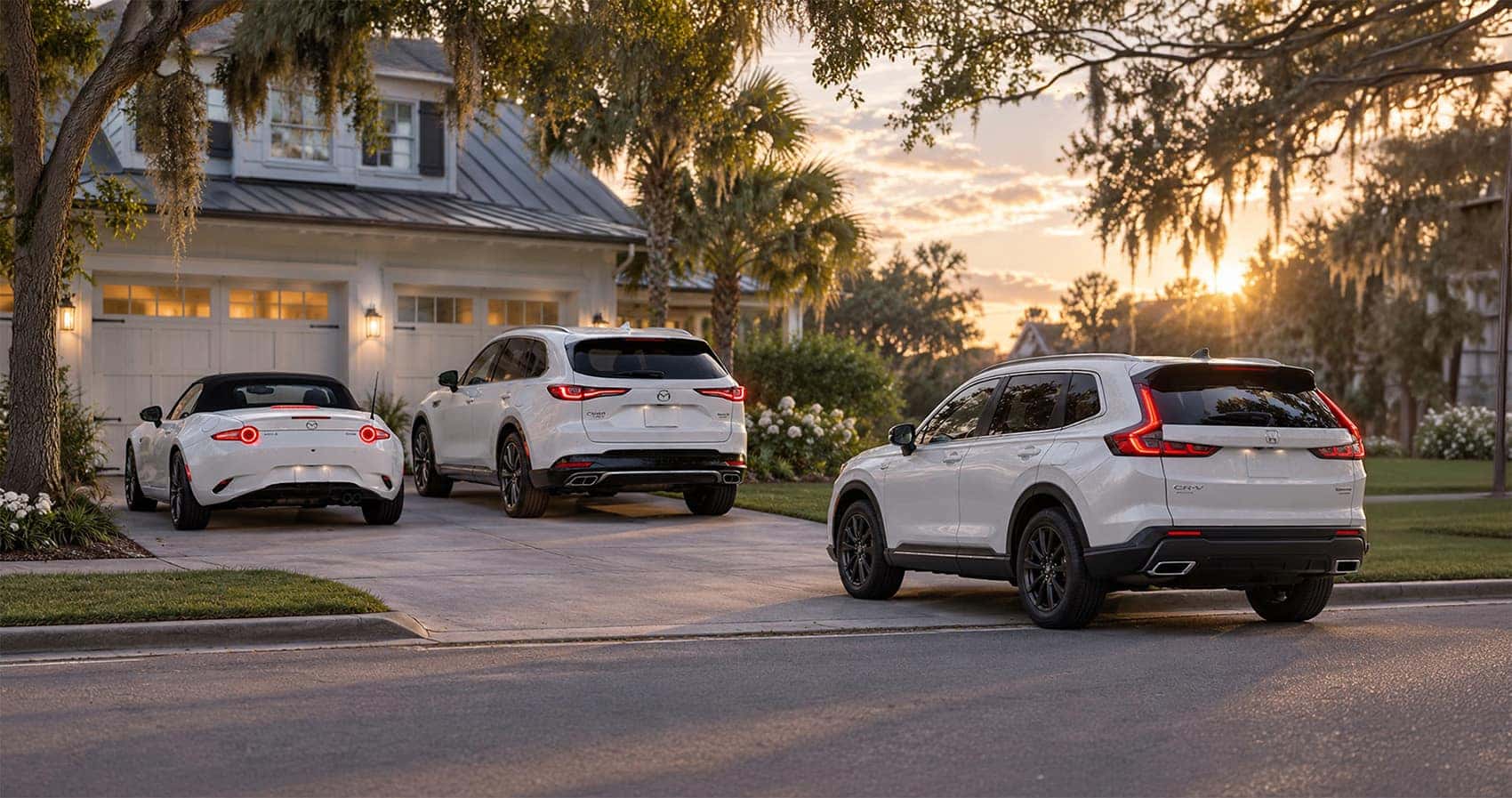
2026 Mazda MX-5 Miata and Mazda CX-90 parked in a Savannah, GA driveway with a 2027 Honda CR-V parked along the curb at sunrise

Where the Brand Tradeoff Becomes Clear

Which Advantages Would You Actually Use?

Mazda and Honda can both meet everyday SUV needs. The more useful distinction is what you want beyond enough room: a rewarding drive, a particular passenger or cargo layout, or a powertrain that fits your routine. Use those priorities to narrow your first test drive.

Mazda

Make the Daily Drive
Feel More Rewarding

Start with Mazda if the vehicle meets your space needs and driving enjoyment remains part of the value. CX-30, CX-5 and CX-50 offer different SUV personalities, with standard AWD across the current Mazda SUV lineup. CX-90 PHEV adds a three-row plug-in hybrid option.*

What to Notice on the Drive

On your usual Savannah-area roads, pay attention to steering response, seat support and how naturally the controls fall to hand. If the Mazda feels better to drive without compromising passenger or cargo needs, that is a benefit you can enjoy every day.

Honda

Choose the Layout
That Fits Your Household

Start with Honda when a specific vehicle layout solves a recurring need. CR-V offers a roomy compact-SUV cabin, Pilot offers three rows, Odyssey brings sliding doors, and Ridgeline provides an open pickup bed. Honda also offers hybrid passenger cars for shoppers who do not need an SUV.*

What to Check in Person

Bring the passengers and gear you carry most often. Rear-seat access, child-seat fit and usable luggage space may outweigh another comfort upgrade. If sliding doors or a pickup bed are essential, those formats offer a clearer reason to start with Honda.

When Both Brands Meet Your Needs

Let the Closest SUVs Settle the Choice

Start with CX-30 versus HR-V, CX-5 or CX-50 versus CR-V, and three-row CX-90 versus Pilot. These are useful shopping pairs, not identical vehicles. Compare passenger comfort, cargo fit and cabin controls on similar drives.

Then compare the drivetrains, equipment and full purchase quotes you would actually choose. Once both vehicles meet your must-haves, the better fit is the one whose everyday advantages you will appreciate most often.

Still weighing two strong choices?
Take the quiz to choose your first test drive.

Three Questions, One Better Starting Point

Which Brand Deserves Your First Test Drive?

Choose what matters most about the drive, the type of vehicle you need and the equipment you want. Your result suggests where to start—not a verdict on every Mazda or Honda model.

Use these three questions to narrow your first test drive:

  1. Does driving enjoyment or passenger practicality matter more to you?
  2. Do you need a three-row plug-in hybrid, a different vehicle body style, or a conventional SUV?
  3. Do you prefer included AWD, an available FWD configuration, or a comparison based on the final equipment and quote?

Use the comparison above to check seating, charging needs, equipment and pricing before deciding which vehicle deserves a test drive.

Question 1
0 answered

Decision Question


Mazda vs Honda FAQs

Which Mazda SUV is closest to the Honda CR-V?

The 2027 CX-5 is a natural everyday compact-SUV cross-shop for the 2027 CR-V. The CX-50 adds a more outdoors-oriented Mazda alternative, while the CX-50 Hybrid is the Mazda hybrid SUV to compare with the CR-V Hybrid. These vehicles differ in size, equipment and drivetrain, so match the model years and trims before deciding.*

Does every Mazda SUV include AWD?

Yes. AWD is standard across Mazda’s current U.S. crossover SUV lineup; the CX-50 Hybrid uses electronic AWD. Honda’s HR-V and CR-V offer FWD or AWD configurations, while the Passport includes AWD. No AWD system replaces suitable tires, safe speeds and attentive driving.*

Does Honda offer a three-row plug-in hybrid like the CX-90 PHEV?

No. The 2027 Mazda CX-90 PHEV combines three-row seating, external charging and a gasoline engine. Honda’s Pilot offers three-row seating with gasoline power, while the CR-V Hybrid requires no external charging. Neither duplicates the CX-90 PHEV’s seating-and-powertrain combination in the current U.S. lineup.*

Is a Mazda or Honda SUV always less expensive?

No. Starting prices change by model, year, trim and drivetrain. Mazda includes AWD on its current SUVs, while Honda’s HR-V and CR-V offer FWD configurations that can lower their starting price. Compare equivalent equipment, destination charges and the complete out-the-door quotes rather than base MSRP alone.*

Are Mazda and Honda warranties the same?

Their headline coverage periods are similar: new U.S. vehicles generally include a 3-year/36,000-mile new-vehicle limited warranty and a 5-year/60,000-mile powertrain limited warranty, whichever comes first. Covered components, exclusions, and separate hybrid-battery, emissions and roadside-assistance terms can differ. Check the warranty booklet for the exact vehicle.*

Does Honda’s included maintenance cover every service?

No. For eligible 2026 and 2027 Honda vehicles, Honda Service Pass covers specified factory-scheduled maintenance for 1 year or 12,000 miles, whichever comes first. Qualifying Maintenance Minder services can include oil and filter changes, tire rotations and multi-point inspections at participating Honda dealerships. Other maintenance and repair expenses are not automatically covered.*

Shopping & Ownership Support

Local Guidance for the Purchase
& the Miles That Follow

At J.C. Lewis Mazda, the relationship extends beyond choosing a vehicle. Our Savannah team can help you work through purchase details, plan a convenient handoff and return for Mazda service as ownership needs change.

Savannah Roots Dating Back to 1912

The J.C. Lewis automotive family began in Savannah in 1912. More than a century of local history connects our dealership to generations of Coastal Georgia and Lowcountry drivers.

Understand the Full Purchase Picture

Review vehicle pricing, applicable taxes and fees, financing options and your trade value together. Our team can explain the out-the-door figures so you can evaluate more than the monthly payment.

Ask About Southeast Home Delivery

Shopping from the Lowcountry or farther away? Eligible purchases may qualify for home delivery across the Southeast. Ask us to confirm your address, delivery availability and transaction requirements before making plans.

Factory-Trained Service, Including Saturdays

Keep maintenance and repairs connected to a Mazda-trained team using Genuine Mazda Parts. With online service scheduling and Saturday service hours, you have more ways to fit an appointment into your week.

Visit Our Savannah Dealership

J.C. Lewis Mazda

10101 Abercorn St
Savannah, GA 31406

Plan your visit, ask about a Mazda or take the next purchase step from home.

TAKE YOUR NEXT STEP
Browse Inventory or Continue Learning


Disclaimers:
*Model Lineup & Equipment: Model lineup, features, pricing and programs reflect current U.S. information checked November 6, 2026 and can change. The market includes multiple model years; verify the exact vehicle, equipment and availability before purchase. Model-role comparisons do not imply identical size, seating or capability.
*Pricing: MSRP is Manufacturer’s Suggested Retail Price, not an advertised sale price. MSRP examples exclude destination and handling, taxes, title, license, options, accessories and dealer fees. Dealers set actual prices. The 2026 CX-30 2.5 S and CX-50 Hybrid Preferred examples include AWD; the 2027 HR-V LX and CR-V Sport Hybrid examples use FWD. They are starting configurations, not matched equipment packages.
*Fuel Economy: EPA-estimated/rated fuel economy is configuration-specific: 2026 CX-50 Hybrid AWD, 38 MPG combined; 2027 CR-V Sport Hybrid/Sport-L Hybrid FWD, 40 MPG combined; CR-V Sport Hybrid/Sport-L Hybrid/Sport Touring Hybrid AWD, 37 MPG combined; CR-V TrailSport Hybrid AWD, 35 MPG combined. Actual mileage varies with driving conditions, habits, vehicle condition, maintenance and other factors. Fuel and electricity costs affect any savings calculation; savings are not guaranteed.
*Charging & Electrified Operation: PHEV/EV operation depends on charging equipment, access, weather, battery condition and use. PHEVs retain a gasoline engine; a conventional hybrid does not require external charging. Honda CR-V e:FCEV is a limited-market hydrogen fuel-cell vehicle with plug-in capability, not a conventional gasoline-PHEV substitute for Savannah shoppers.
*AWD & Driver Assistance: AWD, trail equipment and driver-assistance features have limitations. AWD does not improve braking traction or eliminate tire, road and weather limits. Braking, lane, cruise, camera and parking-assistance systems do not replace attentive driving or guarantee avoidance of a collision. Follow the owner’s manual. Exact feature availability varies by model, model year, trim and equipment.
*Warranties & Maintenance: Warranty and roadside-assistance coverage is limited and subject to eligibility, exclusions, maintenance requirements and the applicable time or mileage limit, whichever comes first. The headline powertrain comparison concerns gasoline/hybrid models, not Prologue EV terms. Battery and emissions warranties can differ by model and state. Honda Service Pass covers eligible scheduled services during 1 year/12,000 miles under program terms and Maintenance Minder requirements; it is not unlimited maintenance. Review the exact vehicle’s warranty and program documents.
*Connectivity, Reviews & Dealer Programs: Connectivity requires compatible devices and may require data, subscriptions or trial eligibility. Third-party reviews and awards cited are specific to the named 2026 vehicles and publication; they do not establish brand-wide superiority. Dealer home delivery arrangements and eligibility depend on location and scheduling; confirm details with our team. Financing is subject to lender approval and terms.
*Cargo: The cargo example compares a 2026 Mazda CX-50 Hybrid with a 2027 Honda CR-V Sport Hybrid, with rear seats upright. Published cargo measurements are not a guarantee that the same objects fit; usable shape, passenger needs and vehicle configuration affect packing.
*RepairPal's published Mazda and Honda brand reliability ratings. RepairPal says its reliability-rating dataset includes 2010–2019 model-year vehicles; these are historical averages, not reliability predictions for 2026 or 2027 models. Annual costs include repair and maintenance; visit frequency measures unscheduled shop visits, and severity reflects the share of repairs classified as severe. Other studies may use different samples and methods.


Saved Vehicles

You don't have any saved vehicles!

Look for this Save icon

Once you've saved some vehicles, you can view them here at any time.

Get Directions

10101 Abercorn St, Savannah, GA, 31406
J.C. Lewis Mazda 31.991009716730076, -81.13119930230253.
tag ->